What Golf Cart Battery Voltage Do You Need? A Complete Guide to 36V, 48V and 51.2V Systems
Choosing the right golf cart battery is not simply a matter of selecting the highest capacity or the newest lithium technology. Battery voltage is one of the first specifications that must match the golf cart’s electrical system.
The most common golf cart battery voltage systems are 36V and 48V, while 51.2V lithium batteries have become increasingly popular as a modern replacement for conventional 48V lead-acid battery systems. Higher-voltage platforms such as 72V are also used in performance-oriented and utility applications.
For golf cart manufacturers, distributors, dealers, fleet operators, and battery replacement businesses, understanding voltage is essential. Choosing an incompatible battery can affect the controller, motor, charger, display, and overall vehicle performance.
This guide explains how golf cart battery voltage works, how to identify your existing system, the differences between 36V, 48V, and 51.2V batteries, and what to consider when upgrading from lead-acid to lithium.
What Is Golf Cart Battery Voltage?
Golf cart battery voltage refers to the electrical potential supplied by the battery system to the cart’s motor and other electrical components.
Unlike a typical automobile, which generally uses a 12V electrical system, electric golf carts commonly operate with much higher system voltages.
The most common configurations include:
- 36V golf cart battery systems
- 48V golf cart battery systems
- 51.2V lithium golf cart battery systems
- 72V golf cart battery systems for specialized applications
The voltage of a golf cart is normally determined by the motor, controller, charger, wiring, and other electrical components installed by the manufacturer.
This means you should not choose a battery based only on physical size or amp-hour capacity. The battery voltage must be compatible with the vehicle’s electrical architecture.
For example, replacing a 48V golf cart battery with an unrelated 36V battery is not a simple battery swap. The lower voltage may not provide the electrical conditions required by the controller and motor.
Golf Cart Battery Voltage at a Glance
The important point is that nominal voltage and actual operating voltage are not always identical. This is particularly important when comparing lithium batteries with lead-acid batteries.
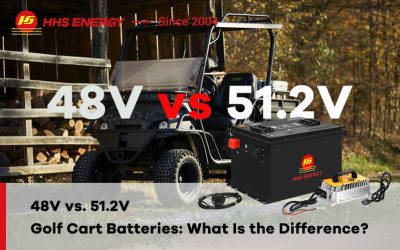
Why Is a 51.2V Battery Called a 48V Golf Cart Battery?
This is one of the most common questions when customers begin comparing lithium golf cart batteries.
A typical LiFePO4 cell has a nominal voltage of approximately 3.2V. A battery consisting of 16 cells connected in series has a nominal voltage of:
3.2V × 16 = 51.2V
Therefore, a 16S LiFePO4 battery is commonly described as a 51.2V lithium battery. However, it is often marketed as a 48V lithium golf cart battery because it is designed to replace conventional 48V lead-acid battery systems.
This distinction is important for buyers. When you see terms such as:
- 48V lithium golf cart battery
- 51.2V golf cart battery
- 48V LiFePO4 golf cart battery
- 51.2V LiFePO4 battery
they may refer to essentially the same 48V-class lithium application, depending on the manufacturer’s terminology and electrical specifications.
The correct approach is not to judge compatibility solely from the number printed in the product name. Always check the battery’s:
- Nominal voltage
- Maximum charging voltage
- Continuous discharge current
- Peak discharge current
- BMS specifications
- Charger compatibility
- Controller compatibility
36V vs. 48V Golf Cart Battery: What’s the Difference?
The difference between 36V and 48V systems goes beyond the number printed on the battery. The voltage affects how the electrical system delivers power to the motor.
36V Golf Cart Battery Systems
36V systems have been widely used in older electric golf carts and remain suitable for applications where extreme acceleration or high power is not required.
A traditional 36V lead-acid configuration may consist of:
- Six 6V batteries
- Three 12V batteries
A lithium replacement can instead use a dedicated 36V-class LiFePO4 battery pack.
Advantages of 36V
- The original golf cart is designed for 36V
- The vehicle is used mainly on flat terrain
- Moderate speed is sufficient
- The customer wants a straightforward replacement
- The existing controller and motor are designed around 36V
Limitations of 36V
Compared with a properly engineered 48V system, a 36V platform may have less available electrical power for demanding applications. Heavy loads, steep hills, frequent acceleration, or utility use can place greater demands on the battery and electrical system. For this reason, many newer golf cart platforms use 48V-class systems.
48V Golf Cart Battery Systems
48V is one of the most common voltage classes for modern electric golf carts.
Traditional lead-acid configurations can include:
- Six 8V batteries
- Four 12V batteries
Lithium systems can replace the entire multi-battery arrangement with one integrated battery pack.
A 48V lithium golf cart battery can provide several practical benefits:
- Lower battery weight
- Higher usable energy
- More stable voltage during discharge
- Faster charging potential
- Reduced maintenance
- Integrated battery management
- Easier battery installation
- Better packaging flexibility
For B2B buyers, 48V lithium systems are particularly interesting because one battery pack can replace multiple individual lead-acid batteries while simplifying the vehicle’s battery compartment.
51.2V LiFePO4 Golf Cart Batteries
For many 48V-class golf carts, 51.2V LiFePO4 batteries have become an important lithium replacement option. The chemistry is based on lithium iron phosphate rather than traditional lead-acid technology.
A typical 51.2V LiFePO4 golf cart battery uses a 16-cell series architecture. Its major advantages can include:
1. Stable Voltage
LiFePO4 batteries generally maintain a relatively stable voltage throughout much of their discharge cycle. This can help electric golf carts maintain more consistent performance compared with lead-acid batteries whose voltage can decline more noticeably as they discharge.
2. Higher Usable Capacity
Battery capacity is not determined by Ah alone. The approximate stored energy can be calculated as:
Energy (Wh) = Voltage (V) × Capacity (Ah)
For example: 51.2V × 100Ah = 5,120Wh (5.12kWh). This provides a more useful way to compare battery packs than looking at Ah alone.
3. Lower Weight
Lithium batteries can be substantially lighter than equivalent lead-acid battery banks. Reducing battery weight can affect the overall vehicle load, acceleration, handling, and energy consumption.
4. Less Maintenance
Traditional flooded lead-acid batteries require regular maintenance, including water-level inspection and terminal cleaning. A properly designed LiFePO4 battery with an integrated BMS eliminates routine watering requirements.
Voltage vs. Amp Hours: What’s More Important?
This is another common source of confusion. Voltage and amp hours measure different things.
Voltage describes the electrical potential of the battery system. Amp hours describe the battery’s nominal charge capacity.
For example: 48V 100Ah, 51.2V 100Ah, 48V 150Ah are not equivalent battery specifications.
Therefore, when comparing golf cart batteries, buyers should consider: Voltage + Ah + usable energy + discharge capability, rather than looking at Ah by itself.
How Does Golf Cart Battery Voltage Affect Performance?
Voltage is an important factor in golf cart performance, but it is not the only factor. Motor power, controller programming, battery discharge capability, vehicle weight, tire size, gearing, terrain, and load all affect performance.
Speed
Increasing system voltage can provide the electrical system with greater power potential when the motor and controller are designed to support it. However, simply installing a higher-voltage battery does not automatically make every golf cart faster. The controller and motor must be compatible with the new voltage.
Torque and Hill Climbing
Golf carts frequently operate on hills, grass, rough terrain, uneven surfaces, heavy loads, and utility applications. The battery must be capable of delivering sufficient current to the motor system. This is why continuous discharge current and peak discharge current are important specifications when selecting a lithium battery.
A battery with a large Ah rating but insufficient discharge capability may not perform as expected under heavy acceleration or climbing conditions.
Does Higher Voltage Always Mean Longer Range?
No. This is an important misconception. A higher voltage does not automatically mean a longer driving range.
Range depends on total usable energy and vehicle efficiency. For example:
- 48V × 100Ah = 4.8kWh
- 51.2V × 100Ah = 5.12kWh
The second battery has approximately 6.7% more nominal energy. But if you compare a 48V 150Ah battery with a 51.2V 100Ah battery, the 48V battery contains more nominal energy (7.2kWh vs 5.12kWh). Therefore, when evaluating range, look at Wh or kWh, not voltage alone.
How to Determine Your Golf Cart Battery Voltage
Before ordering a replacement battery, identify the original electrical system. There are several ways to do this.
- Check the Existing Battery Labels – Lift the seat and inspect the battery compartment. Look for labels showing 6V, 8V, 12V, 36V, 48V.
- Count the Batteries – Calculate system voltage by adding batteries connected in series. For example: 6 × 6V = 36V; 6 × 8V = 48V; 4 × 12V = 48V.
- Check the Golf Cart Manual – The vehicle owner’s manual should identify the intended voltage.
- Inspect the Charger – A charger designed for 36V should not be used with a 48V battery.
- Use a Multimeter – Confirm actual voltage, but note that measured voltage can differ from nominal depending on state of charge, chemistry, temperature, etc.
Do not identify the battery system from one voltage measurement alone.
Can You Upgrade a 36V Golf Cart to 48V?
Technically, a 36V golf cart can sometimes be converted to 48V, but this is not simply a battery replacement. A proper conversion may require checking or replacing:
- Battery
- Charger
- Motor controller
- Motor
- Solenoid or contactor
- Wiring, cables
- Display, DC-DC converter
- Battery mounting system
For B2B applications, a complete system evaluation is usually more practical than recommending a battery-only voltage conversion.
Can You Replace Lead-Acid Batteries With Lithium?
Yes, lithium batteries are commonly used as replacements for lead-acid golf cart battery systems, but compatibility must be verified. A lithium conversion normally involves replacing the original lead-acid battery bank with a dedicated lithium battery pack and using a compatible charger.
For example, a conventional 48V lead-acid golf cart may use 6 × 8V lead-acid batteries; a lithium replacement could instead use 1 × 51.2V LiFePO4 battery pack.
Important specifications include nominal voltage, charging voltage, continuous/peak discharge current, BMS protection, charger compatibility, communication interface, physical dimensions, and mounting method.
Why a BMS Matters in a Lithium Golf Cart Battery
A lithium battery for a golf cart should not be viewed simply as a group of cells. A properly engineered battery pack includes a Battery Management System (BMS) that monitors and controls overcharge, over-discharge, overcurrent, short circuit, temperature, cell voltage, and state of charge.
For golf cart applications, the BMS also needs to be matched to the vehicle’s expected load. A battery intended for a low-power application may not be suitable for a golf cart that frequently climbs hills or carries heavy loads.
48V Lead-Acid vs. 51.2V Lithium Golf Cart Batteries
The actual performance and lifespan depend on battery quality, operating conditions, charging practices, temperature, and system design.
What Golf Cart Battery Voltage Is Best?
There is no universal answer. The correct voltage depends primarily on the golf cart’s original electrical architecture.
- Choose 36V when: The golf cart is designed for 36V, you are replacing an existing 36V system, the cart has moderate power requirements, or the application is relatively light duty.
- Choose 48V when: The golf cart is designed for a 48V system, you need a good balance of performance and efficiency, the vehicle is used for transportation, recreation, or utility applications, or you want a common voltage platform.
- Consider 51.2V lithium when: You are replacing a 48V lead-acid battery bank, lower battery weight is important, reduced maintenance is desired, stable voltage is important, the vehicle needs greater usable energy, or you want an integrated lithium battery solution.
- Consider 72V when: The vehicle is specifically designed for 72V, higher performance is required, the motor and controller support 72V, or the application demands greater electrical power.
The key rule is simple: Match the battery voltage to the golf cart’s electrical system before comparing capacity or price.
Choosing the Right Golf Cart Battery for Club Car, EZGO and Yamaha
Golf cart manufacturers such as Club Car, EZGO, and Yamaha have produced vehicles using different electrical configurations over the years. Therefore, the vehicle brand alone is not enough to determine the correct battery.
You should identify: exact golf cart model, model year, existing battery voltage, motor specification, controller specification, charger specification, battery compartment dimensions, desired capacity, and intended operating conditions.
For battery distributors and OEM customers, this information is especially important because the same golf cart brand may have multiple electrical configurations.
How Many Ah Do You Need for a Golf Cart?
Once voltage is confirmed, the next question is battery capacity. Common lithium golf cart battery capacities include 50Ah, 72Ah, 100Ah, 105Ah, 120Ah, 150Ah, 160Ah, 200Ah.
The appropriate capacity depends on the application. A recreational golf cart used for short trips may not need the same capacity as golf course fleets, resort transportation, neighborhood electric vehicles, utility carts, commercial maintenance vehicles, or heavy-load applications.
For B2B customers, battery capacity should be selected based on the expected duty cycle rather than simply choosing the largest available battery.
How to Calculate Golf Cart Battery Energy
The basic formula is: Battery Energy (Wh) = Voltage × Amp Hours
- 48V 100Ah → 48 × 100 = 4,800Wh (4.8kWh)
- 51.2V 100Ah → 51.2 × 100 = 5,120Wh (5.12kWh)
- 51.2V 150Ah → 51.2 × 150 = 7,680Wh (7.68kWh)
This calculation gives nominal energy. Actual usable energy depends on factors such as battery management settings, discharge limits, temperature, load, battery condition, and system efficiency.
What Should Golf Cart Battery Dealers Check Before Buying?
For dealers, distributors, and importers, the cheapest battery is not necessarily the most competitive product. A reliable golf cart battery supplier should be able to provide detailed technical information.
Before placing a bulk order, ask about:
- Electrical Specifications: nominal voltage, charging voltage, capacity, continuous/peak discharge current, BMS specifications.
- Mechanical Specifications: dimensions, weight, terminal type, mounting method, battery enclosure material.
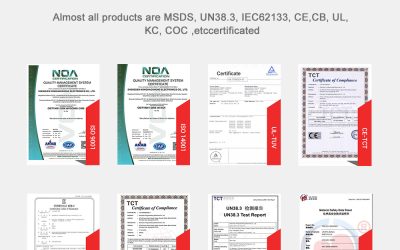
- Safety and Certification: UN38.3, MSDS, CE, UL-related requirements, ISO manufacturing certifications.
- Commercial Requirements: MOQ, OEM/ODM capability, custom labeling, packaging, warranty, production capacity, lead time, technical and after-sales support.
This becomes particularly important when purchasing hundreds or thousands of batteries for distribution.
Why OEM Golf Cart Battery Design Matters
Not every golf cart uses the same battery compartment. A battery manufacturer serving OEM customers may need to customize battery dimensions, cell configuration, voltage, capacity, BMS, communication protocol, connector, cable length, terminal position, display, SOC indicator, Bluetooth functionality, heating system, enclosure, and mounting brackets.
For this reason, OEM golf cart battery manufacturing is different from simply purchasing a standard battery from an online marketplace.
HHS Energy offers customized lithium battery solutions for applications including golf carts, with options for different voltage, capacity, dimensions, BMS configurations, and OEM requirements.
Common Golf Cart Battery Voltage Mistakes
- Mistake 1: Choosing a battery based only on Ah – voltage must be checked first.
- Mistake 2: Assuming 51.2V is too high for a 48V cart – a properly designed 51.2V LiFePO4 is commonly used as a 48V-class replacement, but compatibility must be confirmed.
- Mistake 3: Using the original lead-acid charger – lithium batteries require an appropriate lithium charging profile.
- Mistake 4: Ignoring the controller – the battery, controller, and motor must work together.
- Mistake 5: Comparing batteries only by price – low-cost batteries may have inferior cell quality, BMS performance, cycle life, thermal management, enclosure design, warranty, and technical support.
For commercial buyers, total cost of ownership is often more important than initial battery price.
Golf Cart Battery Voltage: Frequently Asked Questions
Final Thoughts: Choose the Voltage Before the Capacity
Golf cart battery selection should start with voltage compatibility, not price or amp-hour capacity.
A 36V golf cart generally requires a 36V-class battery system. A 48V golf cart can often use a 48V-class lithium battery, including a properly designed 51.2V LiFePO4 battery. Higher-voltage platforms such as 72V require a complete electrical system designed for that voltage.
Once the voltage has been confirmed, you can then compare: Ah → kWh → discharge current → battery dimensions → BMS → charger → cycle life → warranty → total cost of ownership.
For golf cart manufacturers, dealers, distributors, and fleet operators, lithium technology provides an opportunity to move from multiple heavy lead-acid batteries to a more integrated battery solution.
The best battery is not necessarily the battery with the highest voltage or largest capacity. It is the battery that is electrically compatible, mechanically suitable, powerful enough for the application, and properly matched to the vehicle’s expected duty cycle.
For businesses looking for customized golf cart lithium battery solutions, working directly with an experienced battery manufacturer can also make it easier to customize voltage, capacity, dimensions, BMS, connectors, communication functions, and packaging for different golf cart platforms.
Need the right voltage for your golf cart? Let’s find your perfect match.
HHS Energy provides custom lithium battery packs for 36V, 48V, and 51.2V golf cart systems. We help you choose the correct voltage, capacity, and BMS for your specific vehicle and usage.
HHS Energy — Lithium Battery Solutions for Golf Carts & Electric Vehicles
© 2025 HHS Energy | Smart Battery Technology