Comprehensive Winter Care for Electric Golf Cart Batteries
Winter can be challenging for electric golf carts. Cold temperatures can reduce battery performance, slow charging, increase energy consumption, and affect the overall driving range of the vehicle. For golf cart owners, dealers, fleet operators, and manufacturers, understanding how to protect batteries during cold weather is essential for maintaining reliable performance and extending battery service life.
This is particularly important as more golf carts transition from traditional lead-acid batteries to lithium technologies such as LiFePO₄. Although lithium batteries generally require less maintenance than lead-acid batteries, they still need proper winter care.
In this guide, we will explain how cold weather affects electric golf cart batteries, how to charge and store them during winter, and the differences between caring for lithium and lead-acid golf cart batteries.
How Does Cold Weather Affect Golf Cart Batteries?
Temperature has a direct effect on battery performance. When the temperature drops, electrochemical reactions inside a battery become slower. As a result, the battery may not deliver energy as efficiently as it does under moderate temperatures.
Depending on the battery chemistry and operating conditions, cold weather can cause:
- Reduced available capacity
- Lower driving range
- Slower charging
- Reduced power output
- Increased voltage drop under load
- Longer charging times
- Greater stress during charging
- Potential battery damage if charging is performed outside the battery’s temperature limits
The severity of these effects depends on the battery chemistry, temperature, state of charge, battery design, and how long the battery is exposed to cold conditions.
Winter Care for Lithium Golf Cart Batteries
Lithium-ion batteries, particularly LiFePO₄ batteries, have become increasingly popular for golf carts because of their high usable energy, low maintenance requirements, long service potential, and relatively stable voltage.
However, one important characteristic should not be overlooked: charging lithium batteries at very low temperatures can be harmful.
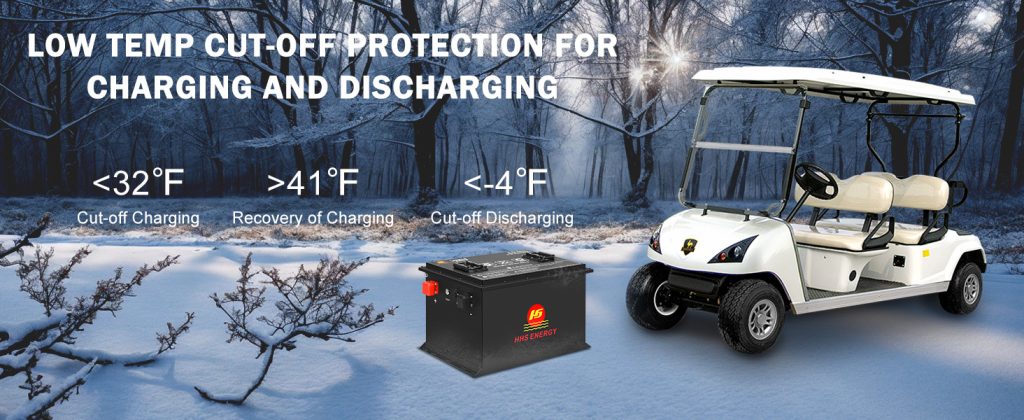
Most LiFePO₄ batteries should not be charged when the internal cell temperature is below the battery manufacturer’s specified minimum charging temperature. The exact limit varies by battery design. Some lithium golf cart batteries include a low-temperature charging protection function, while advanced systems may incorporate battery heating.
Always follow the manufacturer’s charging-temperature specifications.
Can You Charge a Lithium Golf Cart Battery in Winter?
Yes, but the battery temperature matters. A common mistake is to assume that because a lithium battery can discharge in cold weather, it can also be charged under the same conditions. These are not necessarily the same.
A lithium battery may be able to discharge at temperatures below freezing, depending on its specifications, while charging may be restricted to a higher minimum temperature.
This is because charging lithium cells at excessively low temperatures can cause undesirable chemical reactions that may permanently affect cell performance and safety.
Therefore, before charging a lithium golf cart battery during winter:
- Check the battery temperature.
- Review the manufacturer’s charging-temperature specification.
- Keep the battery in a suitable environment whenever possible.
- Allow a cold battery to warm naturally before charging if required.
- Use the recommended lithium battery charger.
- Never bypass the BMS’s low-temperature protection.
Low-Temperature Charging Protection & Heated Batteries
A quality lithium golf cart battery should have a Battery Management System (BMS) that monitors important operating conditions. If the battery detects that its temperature is below the permitted charging range, the BMS may prevent charging.
For applications exposed to harsh winter conditions, a battery with an integrated heating system can provide additional convenience. A heated lithium battery can use a heating element to raise the cell temperature to an appropriate range before or during charging.
Important specifications include:
- Heating activation temperature
- Heating power and duration
- Charging conditions and BMS control
- Energy consumption and charger compatibility
How Cold Weather Affects Golf Cart Range
One of the most noticeable winter effects is reduced driving range. A golf cart may travel fewer miles on a cold day than it does under moderate-temperature conditions, even when the battery appears fully charged.
Several factors can contribute:
- Battery Performance: Cold temperatures reduce the amount of energy that can be delivered efficiently.
- Increased Electrical Resistance: Lower temperatures increase internal resistance, causing greater voltage drop under load.
- Heating Loads: Cab heating, heated seats, defrosting, lights, and accessories consume extra energy.
- Tire Pressure: Cold weather reduces tire pressure, increasing rolling resistance.
- Driving Conditions: Wet roads, snow, hills, and rough surfaces require more energy.
A reduction in winter range does not necessarily mean the battery is defective.
Winter Care for Lead-Acid Golf Cart Batteries
Lead-acid batteries require a different winter maintenance strategy. Common types include flooded, AGM, and gel.
Before winter storage:
- Check Water Levels: For flooded batteries, ensure electrolyte is within recommended range. Do not overfill.
- Clean the Terminals: Remove corrosion and ensure connections are tight.
- Fully Charge the Battery: A lead-acid battery should not be left severely discharged for extended periods to avoid sulfation.
For storage, maintain an appropriate state of charge and monitor periodically.
How to Store a Lithium Golf Cart Battery in Winter
If your golf cart will not be used for several weeks or months, proper storage helps preserve battery performance.
- Inspect the battery – check condition, cables, terminals, BMS status, and charger.
- Follow manufacturer’s recommended storage SOC – many lithium batteries prefer moderate SOC (e.g., 50–60%) rather than 100% for long-term storage.
- Disconnect unnecessary loads to reduce parasitic discharge.
- Store in a suitable environment – dry, clean, temperature-controlled, avoid extreme cold, snow, and moisture.
For lead-acid, maintain a full charge and check regularly.
Lithium vs. Lead-Acid: Winter Characteristics
Lithium batteries can offer significant advantages, but winter performance still depends on proper battery engineering and temperature management.
Winter Maintenance Checklist
Lithium Battery
- Check battery condition
- Check SOC
- Inspect cables and terminals
- Confirm BMS operation
- Verify charger compatibility
- Check low-temperature protection
- Follow storage temperature/SOC
- Disconnect unnecessary loads
- Keep battery dry
- Avoid charging below specified temp
Lead-Acid Battery
- Fully charge before storage
- Check electrolyte level
- Inspect terminals
- Clean corrosion
- Check cables
- Avoid prolonged deep discharge
- Monitor battery voltage
- Protect from extreme cold
- Follow charging recommendations
Winter Charging Tips
- Don’t charge a frozen lithium battery – warm it naturally or use heating if available.
- Use the correct charger – lithium requires a compatible charging profile.
- Don’t bypass BMS protection – it exists to prevent unsafe operation.
- Avoid outdoor charging in extreme conditions – charge in a dry, protected environment when possible.
Proper charging habits are crucial to prevent damage and maintain performance.
Choosing a Golf Cart Battery for Cold Climates
If your golf cart operates in a cold climate, evaluate batteries beyond voltage and Ah. Ask about:
- Temperature specifications: operating, charging, storage, cutoffs
- Battery protection: BMS temperature monitoring, low-temperature charging protection, overcurrent/charge/discharge protection
- Heating: built-in heating, power, automatic control, activation temperature
- Mechanical design: moisture resistance, vibration resistance, terminal protection, enclosure durability
For commercial fleets, a standardized winter management program can reduce downtime and simplify maintenance.
How HHS Energy Supports Golf Cart Battery Applications
For golf cart manufacturers, distributors, and fleet operators, winter performance should be considered during the battery design stage. A customized lithium golf cart battery can be designed around voltage, capacity, dimensions, discharge current, BMS, charger, communication, operating temperature, heating requirements, and mounting structure.
HHS Energy provides OEM and ODM lithium battery solutions for golf carts and other electric vehicle applications, helping B2B customers develop battery packs according to their vehicle and operating requirements.
With proper winter care, a well-designed golf cart battery can continue to provide reliable performance when temperatures drop.
Winter Care FAQs
Prepare your golf cart for winter with the right battery solution.
HHS Energy provides custom lithium battery packs designed for cold-weather performance. We help you choose the right voltage, capacity, BMS, and heating options to keep your fleet running reliably all season.
HHS Energy — Lithium Battery Solutions for Golf Carts & Electric Vehicles
© 2025 HHS Energy | Smart Battery Technology