Golf Cart History: From Early Electric Vehicles to Modern Lithium-Powered Carts
Golf carts have evolved from simple mobility vehicles into versatile electric transportation solutions used on golf courses, in residential communities, resorts, campuses, industrial facilities, and other environments. Their development reflects nearly a century of innovation in vehicle design, electric motors, battery technology, and personal transportation.
The history of golf carts began before they became a familiar sight on golf courses. Early motorized carts were often developed to help people who had difficulty walking long distances. During the 1950s, specialized golf cars began gaining wider acceptance among golfers, creating opportunities for manufacturers to develop dedicated vehicles for the sport. Over subsequent decades, improvements in chassis design, steering, powertrains, and batteries transformed the industry.
Today, golf carts are available with electric and gasoline powertrains, while lithium iron phosphate (LiFePO₄) batteries are becoming an important option for buyers seeking lower weight, reduced maintenance, and faster charging. Many modern golf carts also incorporate digital displays, advanced controllers, connected features, and configurations designed for use beyond golf courses.
This guide explores the complete history of golf carts, from their early origins and commercial development to their expansion into everyday transportation and the rise of modern battery-powered vehicles.
Quick Answer: When Were Golf Carts Invented?
Motorized golf cart-like vehicles appeared in the 1930s, although their early use was limited. By the early 1950s, golf clubs and manufacturers were developing vehicles specifically for golfers, and golf carts gained broader acceptance during the middle of that decade.
Several important milestones shaped the industry:
- 1930s: Early motorized mobility vehicles and experimental golf carts appeared.
- 1951: Marketeer began producing electric golf carts commercially, while Thunderbird Country Club documented its own early golf cart development.
- 1954–1958: E-Z-GO, Cushman, and Club Car entered the growing market.
- 1960s–1970s: More manufacturers entered the industry, and gasoline-powered models gained popularity.
- Late 1970s–1980s: Golf carts expanded into utility transportation, residential communities, and other applications.
- 1990s–2000s: The industry experienced corporate consolidation and continued improvements in vehicle design and electronics.
- 2010s–2020s: Lithium batteries, electronic controls, connected features, and low-speed vehicle applications became increasingly important.
There is no universally agreed single inventor or date that explains the entire history of the golf cart. Early motorized mobility vehicles, club-developed carts, and mass-produced electric golf cars represent different stages in its evolution.
1. Before Golf Carts: Golf Transportation in the Early 20th Century


Before motorized golf carts became available, walking was the normal way to play golf. Golfers carried their own clubs or relied on caddies to transport their bags between holes.
This traditional approach was central to the game, but it presented practical challenges. Golf courses could cover large areas, and a full round involved considerable walking. Players with mobility limitations, older golfers, and people recovering from injuries could find it difficult to complete a round on foot.
As motor vehicles became more common in the early 20th century, small personal transportation vehicles offered a possible solution.
The first golf cart-like vehicles were not necessarily designed exclusively for golf. Some originated as mobility aids or compact electric and gasoline-powered vehicles that could be adapted for use on golf courses.
This distinction matters when tracing the history of golf carts. The development of the modern golf car was not a single invention that immediately created today’s industry. It was a gradual process in which existing vehicle concepts were adapted, redesigned, and eventually manufactured specifically for golf.
Why was a motorized golf cart needed?
Several practical considerations encouraged the development of motorized transportation on golf courses:
- Reducing the physical demands of walking long distances.
- Helping players with limited mobility participate in golf.
- Transporting golf bags and equipment more conveniently.
- Improving the efficiency of moving around large courses.
- Creating a more accessible recreational experience.
These needs helped establish the foundation for the dedicated golf carts that emerged in the following decades.
2. The 1930s: The Early Origins of Motorized Golf Carts
The 1930s represent an important early period in golf cart history. Motorized vehicles suitable for short-distance transportation began appearing in contexts that later influenced golf cart development.
Some historical accounts describe a custom-built electric golf cart dating to 1932. Other accounts emphasize early experiments with motorized vehicles during the late 1930s. These early vehicles did not immediately become standard equipment on golf courses.
At this stage, the idea was ahead of the market. Golfers were accustomed to walking, golf courses had not universally adopted motorized transportation, and early vehicles still faced limitations in reliability, maneuverability, and practical design.
Early electric vehicles and mobility applications
Small electric vehicles offered several characteristics that suited short-distance transportation:
- Relatively quiet operation.
- No gasoline engine exhaust at the point of use.
- Simple controls.
- Suitability for relatively short trips.
- Potential for use in enclosed or pedestrian-oriented environments.
However, early battery technology and electric vehicle components were less advanced than those available today. Battery weight, charging requirements, driving range, and vehicle durability all affected practicality.
The earliest golf cart-like vehicles therefore remained niche products rather than becoming widespread recreational vehicles.
A gradual transition toward golf-specific design
Early mobility vehicles also demonstrated that simply placing a motorized vehicle on a golf course was not enough. Golf-specific vehicles needed to accommodate golf bags, travel across turf, turn within narrow paths, and operate safely around players. These requirements would influence the design of later models, including wider wheels, more practical seating, dedicated golf bag racks, and vehicle layouts suited to golf course conditions.
3. The Early 1950s: Golf Carts Begin to Gain Acceptance


The early 1950s marked a turning point. Golf clubs and commercial manufacturers began adapting motorized vehicles specifically for golfers, helping transform the golf cart from an unusual mobility solution into a practical product category.
Two important developments illustrate this period: the work associated with Thunderbird Country Club in California and the commercial production of electric golf carts by Marketeer.
3.1 Thunderbird Country Club’s early golf cart development
According to the historical account published by Thunderbird Country Club, associate golf professional Eddie Susalla helped develop an early golf cart solution in 1951.
The project originated from a practical problem. Some club members had difficulty walking the course but still wanted to play. After seeing a gasoline-powered Autoette mobility vehicle in Long Beach, California, Susalla arranged to bring one to the club and adapt it for golfing.
The early vehicle was a three-wheeled, single-seat machine with hand steering. It did not initially have reverse capability, and modifications were needed to carry golf clubs and accommodate the requirements of the course.
Susalla and the club subsequently developed more practical arrangements, including carts that could accommodate two passengers and improved golf bag placement. The club’s historical account states that Thunderbird had a fleet of approximately a dozen carts by 1952 and more than 100 carts associated with the club and its members by 1953. It also records the development of a four-wheeled design in 1953.
This story illustrates how early golf cart development was driven by practical needs rather than technology alone. The vehicle had to work for golfers, carry equipment, maneuver around trees, and operate on the terrain of an actual golf course. Each of these requirements helped shape subsequent designs.
3.2 Marketeer and the commercial electric golf cart
Another major milestone came in 1951, when Merle Williams’ Marketeer Company began producing electric golf carts in Redlands, California.
Williams had gained experience with electric vehicles during the gasoline-rationing period of World War II. This background helped inform his interest in battery-powered transportation.
Marketeer’s commercial production helped establish a dedicated market for electric golf cars. Rather than depending entirely on individual golf clubs to modify existing vehicles, buyers could obtain purpose-built products from a manufacturer.
Why electric power was attractive
Electric golf carts offered several practical advantages for golf courses:
- Quiet operation that suited recreational environments.
- No exhaust emissions during vehicle operation.
- Straightforward driving controls.
- Suitability for repeated short-distance trips.
- A powertrain that did not require gasoline refueling.
These advantages made electric power particularly attractive for golf courses, where vehicles frequently travel short distances, stop regularly, and operate close to players.
Nevertheless, early electric golf carts had limitations. Batteries were heavy, charging took time, and performance depended on battery condition and vehicle design. These constraints would remain important engineering considerations throughout the industry’s development.
4. 1954–1960: Commercial Manufacturers Establish the Industry


The middle of the 1950s saw the golf cart market expand as more manufacturers recognized its potential.
Historical accounts identify the following important company milestones:
These dates are documented in historical accounts of golf cart development.
4.1 E-Z-GO and the growth of electric golf cars
E-Z-GO became one of the important names in the golf car industry after entering the market in 1954. Early electric golf cars used relatively simple vehicle structures, electric motors, battery packs, and basic driving controls. Their design reflected the engineering capabilities of the period.
One historical account notes that an early E-Z-GO used a 36V battery originally designed for aircraft applications. This illustrates how technology developed for one purpose could be adapted to another emerging market.
4.2 Cushman and practical transportation
Cushman entered golf cart production in 1955. Its participation reflected the broader movement of established vehicle and equipment manufacturers into small motorized transportation. Golf courses needed vehicles that were dependable, straightforward to operate, and suitable for repeated daily use. Commercial adoption depended on more than novelty: vehicles had to withstand regular operation and provide practical value to course operators.
4.3 Club Car and the expanding market
Club Car entered the market in 1958 and eventually became one of the most recognizable golf car manufacturers. As the industry expanded, manufacturers increasingly competed through vehicle durability, handling, passenger accommodation, maintenance requirements, and operating costs.
What early golf carts looked like
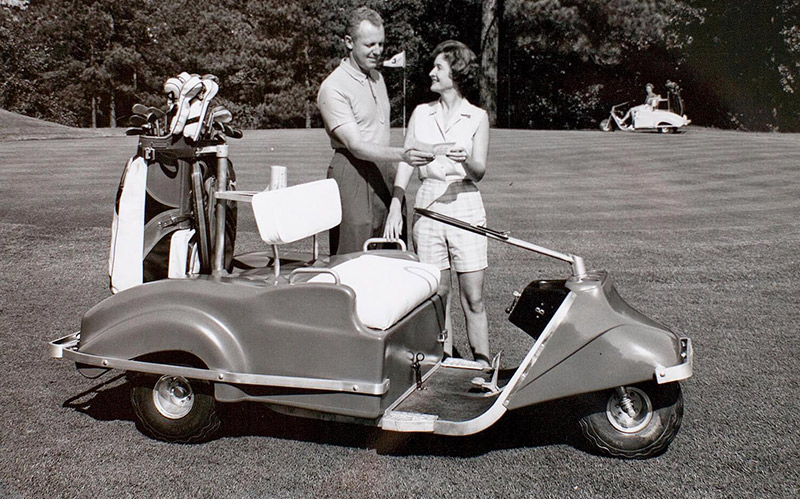
Many early golf carts had three wheels and used tiller-style steering rather than the steering wheel familiar in modern vehicles. Compared with contemporary models, early designs were relatively basic:
- Open seating.
- Minimal weather protection.
- Simple steering and braking systems.
- Limited instrumentation.
- Basic battery and motor controls.
- Dedicated golf bag racks.
As adoption increased, four-wheel designs, more practical seating, and improved handling helped make golf carts easier to operate and more suitable for everyday course use.
5. The 1960s: More Manufacturers and Better Vehicle Designs


During the 1960s, golf carts became more established as commercial products. Additional manufacturers entered the market, and vehicle designs continued to develop.
Taylor-Dunn began producing golf carts in 1961, while Harley-Davidson entered the golf cart business in 1963. These developments reflected the growing interest in compact motorized vehicles for recreational and utility applications.
5.1 From experimental products to everyday equipment
By this period, golf carts were becoming familiar features of many golf courses. Their value was no longer limited to helping a small group of players with mobility challenges. Course operators could use fleets of carts to support more golfers, simplify equipment transportation, and create additional options for players who preferred not to walk the entire course. This increased demand encouraged manufacturers to focus on reliability, serviceability, and standardized production.
5.2 The move toward four-wheel designs
Three-wheel golf carts were an important part of the early industry, but four-wheel designs offered practical benefits for many applications. Four wheels could provide a more stable platform and greater flexibility in chassis and suspension design. Steering wheels also became increasingly common, replacing the tiller controls found on many earlier models. These changes helped make golf carts more familiar to drivers accustomed to conventional vehicles.
5.3 Improving battery-powered performance
Electric golf carts still depended heavily on battery performance. Battery capacity, voltage, discharge capability, and maintenance affected how far a cart could travel and how consistently it performed. For fleet operators, battery management became an important operating consideration. A cart was only useful if its battery could provide sufficient energy for the intended route and return to service within the available charging window. These practical requirements established the importance of battery selection, charging systems, and maintenance—issues that remain relevant to modern golf cart owners and fleet managers.
6. The 1970s: Gasoline Power Gains Popularity


Although electric golf carts had established an important position in the market, gasoline-powered models also gained popularity during the 1970s and 1980s.
Gasoline power offered a different set of advantages, particularly for users who prioritized refueling speed, longer operating periods between energy replenishment, or the ability to support certain demanding applications without waiting for batteries to recharge.
The growth of gasoline-powered carts also demonstrated that the golf cart market was not committed to a single powertrain. Different customers had different priorities, and manufacturers developed products to serve those needs.
Electric vs. gasoline golf carts
Neither technology is automatically best for every application. The right choice depends on usage patterns, operating costs, local regulations, maintenance resources, and performance requirements.
The importance of gasoline-powered models
Gasoline-powered golf carts helped broaden the range of applications available to the industry. They also encouraged manufacturers to improve vehicle design beyond the needs of a traditional golf course. At the same time, electric carts retained their appeal in environments where quiet operation and reduced local emissions were valuable. The coexistence of both powertrains became an enduring characteristic of the golf cart market.
7. The Late 1970s and 1980s: Golf Carts Move Beyond the Course


One of the most important transformations in golf cart history was the move beyond golf courses.
By the late 1970s, manufacturers and users were exploring the potential of compact vehicles for transporting people, tools, supplies, and equipment over short distances. The golf cart’s relatively small size, simple operation, and suitability for low-speed environments made it attractive for many applications.
7.1 The development of utility vehicles
In 1979, Club Car modified a standard cart by adding a rear cargo box, creating a utility vehicle. This development helped establish a broader category of compact vehicles designed for work rather than golf alone. Utility-style vehicles could be used to transport:
- Maintenance tools.
- Landscaping equipment.
- Cleaning supplies.
- Small loads of materials.
- Personnel around large facilities.
The transition from golf transportation to utility transportation expanded the industry’s addressable market.
7.2 Residential communities and resorts
Golf carts gradually found applications in retirement communities, resorts, large residential developments, and other properties where short-distance transportation was useful. These environments often featured private roads, relatively low speeds, and frequent trips between nearby destinations. Golf carts could provide a practical alternative to larger vehicles for certain tasks, although their suitability depended on the terrain, passenger requirements, safety rules, and local operating restrictions.
7.3 Yamaha and the development of neighborhood electric vehicles
Yamaha became another important manufacturer in the golf car industry. Historical accounts identify its golf car activity in the late 1970s and the development of a neighborhood electric vehicle in 1986.
The emergence of neighborhood-oriented electric vehicles reflected a broader change in how compact vehicles were perceived: not merely as golf equipment, but as potential solutions for short-distance transportation. This transition helped prepare the market for later low-speed vehicles and street-oriented electric carts.
8. The 1990s and 2000s: Corporate Consolidation and Technical Progress
By the 1990s, the golf cart industry had become a more mature market. Established manufacturers had developed extensive product lines, dealer networks, service capabilities, and replacement-part ecosystems.
The period also saw significant corporate consolidation. For example, historical industry accounts describe Textron’s acquisition of E-Z-GO and Cushman and the ownership of Club Car by Ingersoll Rand at the time of publication. Ownership structures can change, so historical ownership should not be confused with a statement about current corporate arrangements.
8.1 Why consolidation mattered
As the market matured, manufacturers needed to compete across several dimensions:
- Product reliability.
- Manufacturing scale.
- Dealer and service coverage.
- Parts availability.
- Fleet purchasing relationships.
- Product development and engineering.
- Total cost of ownership.
Larger corporate structures could support broader distribution and investment in engineering, manufacturing, and product development.
8.2 Better motors, controllers, and vehicle electronics
Golf carts also benefited from improvements in electric motors and electronic control systems. A modern electric cart is more than a motor connected to a battery. Its performance depends on how the motor, controller, battery, throttle, wiring, and other components work together. Electronic controllers regulate motor power based on operating conditions and driver input. Improvements in these systems have helped manufacturers deliver more refined acceleration, smoother operation, and more flexible vehicle configurations.
8.3 The continuing importance of lead-acid batteries
For decades, lead-acid batteries served as the foundation of electric golf cart power systems. Their widespread adoption was supported by mature manufacturing processes, established supply chains, relatively low initial costs, and well-developed recycling infrastructure. Battery Council International identifies lead batteries as a long-established energy storage technology with an extensive recycling ecosystem.
However, traditional lead-acid batteries also involve trade-offs, including significant weight, charging time, and—depending on battery type—regular maintenance. As customer expectations changed, these limitations created opportunities for alternative battery technologies.
9. The 2010s: Lithium Batteries Begin Changing Golf Cart Ownership
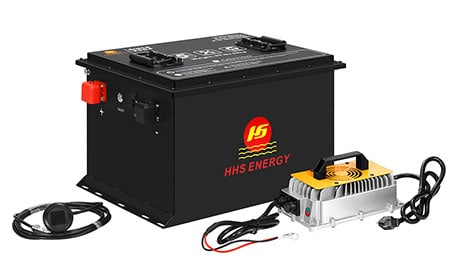

The 2010s brought increasing interest in lithium-ion batteries for electric golf carts and other low-speed vehicles.
Lithium batteries were not a completely new technology, but improvements in cell manufacturing, battery management systems, power electronics, and commercial availability helped make them more practical for a wider range of applications. For golf cart owners and fleet operators, lithium batteries offered a different balance of performance, weight, maintenance, and lifecycle cost.
9.1 Why lithium batteries attracted attention
Compared with conventional lead-acid batteries, appropriately designed lithium battery systems can offer several advantages:
Lower weight: Lithium cells generally provide higher energy density, allowing a battery pack to store useful energy with less mass.
Faster charging: Depending on the battery design and charger, lithium systems can support shorter charging times.
Higher usable energy: A lithium battery may provide more usable energy within its permitted operating range than a lead-acid battery with the same nominal energy rating.
Reduced routine maintenance: LiFePO₄ batteries do not require the electrolyte watering associated with flooded lead-acid batteries.
Integrated battery management: A battery management system can monitor key operating parameters and help protect the battery from abnormal conditions.
Battery Council International identifies higher energy density, faster recharging potential, and lower weight and volume as important characteristics of lithium batteries. It also notes that lead-acid batteries retain advantages in initial cost and established recycling infrastructure.
9.2 Lead-acid and lithium are not interchangeable in every situation
A lithium battery is not automatically a direct replacement for every lead-acid pack. Before converting a golf cart, buyers and installers should confirm:
- Nominal system voltage.
- Charging voltage and charging profile.
- Battery dimensions and mounting.
- Continuous discharge current.
- Peak current requirements.
- Motor controller compatibility.
- Charger compatibility.
- Battery management system requirements.
- Regenerative braking compatibility, where applicable.
- Display, gauge, or communication requirements.
A well-designed conversion should account for the complete vehicle rather than selecting a battery based on voltage alone.
9.3 The rise of LiFePO₄
Lithium iron phosphate, commonly abbreviated as LiFePO₄ or LFP, has become an important chemistry for many golf cart battery applications. Its appeal includes a combination of thermal stability, cycle-life potential, and suitability for repeated charging and discharging. Actual performance depends on cell quality, pack design, operating conditions, and battery management.
For golf cart applications, the battery pack must be engineered to deliver both adequate energy and the current required for acceleration, climbing, carrying passengers, and other demanding operating conditions. This is why battery capacity alone is not enough to determine whether a lithium replacement will perform properly.
10. The 2020s: Modern Golf Carts Become Versatile Personal Vehicles


Today, golf carts occupy a much broader market than their original name suggests. They remain essential vehicles on many golf courses, but their applications now extend to resorts, campuses, gated communities, industrial facilities, retirement communities, and other environments requiring short-distance transportation.
Battery Council International describes this expansion as a shift toward a wider personal-vehicle market, with many carts used outside traditional golf settings.
10.1 Golf carts for residential transportation
Residential communities increasingly use compact electric vehicles for short journeys, property maintenance, and neighborhood mobility. Depending on vehicle design and local laws, some vehicles can be configured or certified for limited road use. However, a golf cart is not automatically street legal simply because it has lights, seat belts, or a higher top speed.
In the United States, street use depends on the vehicle’s classification, applicable federal and state requirements, and local road restrictions. Buyers should verify the rules for their specific location before using a golf cart on public roads.
10.2 Golf carts for commercial and industrial applications
Modern golf carts and related utility vehicles can support operations at:
- Hotels and resorts.
- Universities and campuses.
- Hospitals and large properties.
- Warehouses and industrial parks.
- Airports and event venues.
- Residential developments.
- Landscaping and property maintenance businesses.
These applications can impose different requirements from traditional golf course use. For example, a utility cart may need higher payload capacity, while a passenger shuttle may require more seating, additional electrical accessories, or greater daily range. As applications diversify, battery systems must be matched to the vehicle’s actual workload.
10.3 Connected features and smarter controls
Modern golf carts can incorporate digital displays, battery state-of-charge monitoring, GPS, connectivity, electronic controls, and other convenience features. These systems improve the user experience but also increase the importance of electrical integration. Battery manufacturers and vehicle designers may need to account for auxiliary power consumption, communication protocols, charging behavior, and the interaction between the battery management system and the vehicle electronics.
11. The Evolution of Golf Cart Battery Technology
The development of golf carts is closely connected to the development of rechargeable batteries. Early electric golf carts relied on the battery technology available at the time. Over the decades, battery improvements have helped determine vehicle range, weight, charging requirements, maintenance needs, and operating economics.
The following table summarizes the major stages.
This timeline describes broad industry developments rather than a universal adoption schedule. Different manufacturers and vehicle platforms have moved between technologies at different rates.
11.1 Why battery capacity matters
Battery capacity is commonly expressed in amp-hours (Ah), while energy is expressed in watt-hours (Wh) or kilowatt-hours (kWh). These measurements describe different things.
- Voltage (V): The electrical potential of the battery system.
- Capacity (Ah): The amount of electrical charge the battery can deliver under specified conditions.
- Energy (Wh or kWh): The amount of stored electrical energy.
- Current (A): The rate at which electrical charge flows.
- Power (W or kW): The rate of energy delivery.
A simplified nominal energy calculation is:
Energy (Wh) = Voltage (V) × Capacity (Ah)
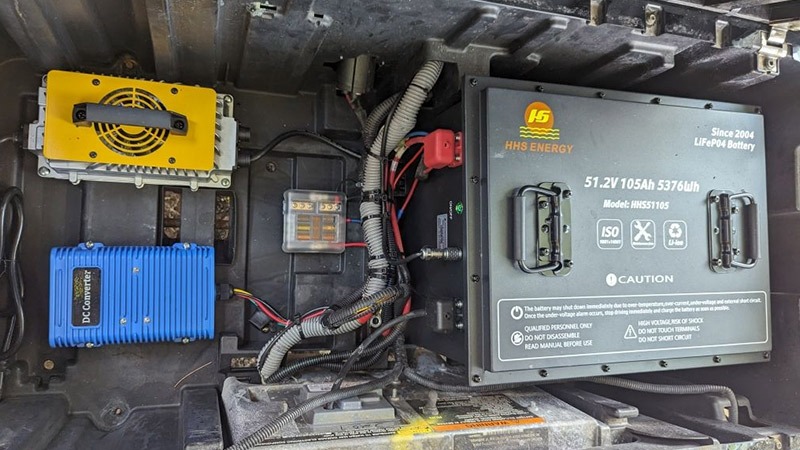
For example, a nominal 51.2V, 105Ah LiFePO₄ battery has a theoretical nominal energy rating of: 51.2 × 105 = 5,376 Wh. That is approximately 5.38kWh of nominal energy. Actual usable energy depends on the battery’s operating limits, system efficiency, temperature, and load.
11.2 Why current capability matters
Golf carts can require substantial current during acceleration, hill climbing, or operation with heavy loads. A battery with adequate capacity may still be unsuitable if its continuous discharge rating or peak-current capability is too low. When selecting a battery, buyers should check both energy capacity and current delivery requirements, along with the controller and motor specifications.
11.3 Battery management systems
Modern lithium golf cart batteries generally incorporate a BMS to monitor battery operation and provide protection against defined abnormal conditions. Depending on the system, BMS functions may include:
- Cell voltage monitoring.
- Overcharge protection.
- Over-discharge protection.
- Over-current protection.
- Temperature monitoring.
- Cell balancing.
- Fault reporting.
- Communication with compatible equipment.
The exact functions vary by product. Buyers should review the manufacturer’s specifications instead of assuming every battery has the same protection or communication features.
12. Lead-Acid vs. Lithium Golf Cart Batteries: Which Is Better?
There is no single battery chemistry that is best for every golf cart. The appropriate choice depends on purchase budget, daily usage, charging opportunities, maintenance capabilities, performance needs, and expected ownership period.
Lead-acid batteries remain a viable option for many golf carts, particularly when upfront cost is a major consideration. Lithium batteries may be attractive for fleets that value reduced downtime, lower vehicle weight, and less routine maintenance. Battery Council International emphasizes that the right choice depends on the specific application and operating requirements.
How to calculate total cost of ownership
A meaningful comparison should consider more than the initial battery price. For fleet operators, the total cost of ownership may include:
- Initial purchase cost.
- Charger and installation costs.
- Electricity or fuel.
- Routine maintenance.
- Downtime.
- Battery replacement frequency.
- Warranty coverage.
- Recycling or disposal.
- Expected vehicle utilization.
A higher-priced battery may be economically attractive in some high-utilization applications, while a lower-cost lead-acid system may remain appropriate for vehicles used occasionally. The decision should be based on realistic operating data rather than broad claims that one chemistry is always superior.
13. The Future of Golf Carts: Smarter, Lighter, and More Connected
The next stage of golf cart development will likely involve improvements across the entire vehicle, including battery systems, electric motors, controllers, safety features, connectivity, and fleet management. Several trends are particularly relevant.
13.1 Higher-performance battery systems
As lithium battery technology develops, manufacturers continue to explore improvements in energy density, charging performance, battery management, and service life. For golf carts, the challenge is to balance energy capacity, power delivery, safety, durability, cost, and compatibility with the vehicle. New battery technologies may eventually offer additional options, but commercial readiness and suitability must be evaluated for each application.
13.2 Smarter battery monitoring
Battery monitoring can help fleet managers understand charge levels, identify abnormal behavior, and plan charging schedules. Depending on the system, future battery and vehicle platforms may incorporate more detailed diagnostics, connectivity, and predictive maintenance features. Such systems can be particularly valuable for commercial fleets that depend on vehicle availability throughout the day.
13.3 Modular battery systems
Modular battery architectures may offer greater flexibility for vehicle manufacturers and fleet operators. A modular design can potentially simplify installation, service, or capacity configuration, provided the system is engineered for the intended application. Battery swapping is another possible approach for some fleet models, although its practicality depends on battery standardization, handling procedures, charging infrastructure, and overall economics.
13.4 More diverse vehicle applications
The boundary between golf carts, utility vehicles, and low-speed personal transportation continues to evolve. Some modern vehicles include additional passenger seating, cargo space, connected features, and electrical accessories that were uncommon in early golf carts. This diversification means battery systems must increasingly be designed around specific use cases rather than relying on a one-size-fits-all approach.
14. What Golf Cart Manufacturers and Battery Buyers Should Consider
As golf carts become more diverse, choosing the right battery system requires a clear understanding of the vehicle and its operating environment. For golf cart manufacturers, importers, distributors, and fleet operators, the following factors are especially important.
Electrical requirements
Confirm the nominal voltage, charging voltage, capacity, continuous current, and peak-current requirements.
Mechanical compatibility
Check battery compartment dimensions, mounting points, terminal locations, cable routing, and weight distribution.
Charger and controller compatibility
Verify that the battery works with the intended charger and vehicle controller. For lithium conversions, check communication requirements and regenerative braking compatibility where applicable.
Operating environment
Consider ambient temperature, daily driving distance, passenger or cargo loads, terrain, and the time available for charging.
Safety and quality
Review battery protection features, applicable certifications, product documentation, warranty terms, and supplier quality controls.
OEM and ODM development
For businesses developing their own golf cart models or private-label battery products, OEM/ODM manufacturing can provide options for custom capacity, enclosure design, BMS configuration, communication functions, branding, and packaging.
HHS Energy provides OEM/ODM lithium battery solutions for B2B applications, including golf cart battery projects. The appropriate design depends on the target vehicle, electrical requirements, installation space, and production specifications.
For more information, visit HHS Golf Energy – Golf Cart Batteries or explore Custom Golf Cart Battery Solutions.
15. Frequently Asked Questions About Golf Cart History
Conclusion
The history of golf carts is a story of practical innovation. Early motorized mobility vehicles provided the foundation, the 1950s established the commercial golf car market, and later decades brought improved vehicle designs, new powertrain options, and applications beyond golf courses.
The industry’s evolution has also been closely linked to battery technology. Lead-acid batteries supported decades of electric golf cart development, while lithium-ion and LiFePO₄ systems have created new possibilities for lower-weight, lower-maintenance, and higher-utilization vehicles.
Today, golf carts are better understood as a diverse category of compact transportation and utility vehicles rather than equipment used exclusively on golf courses. Their future will depend on how effectively manufacturers integrate batteries, motors, controls, safety systems, and vehicle design to meet increasingly varied needs.
For golf cart manufacturers, distributors, fleet operators, and battery businesses, understanding this history provides useful context for evaluating modern vehicle platforms and the next generation of battery-powered mobility solutions.
Powering the next chapter of golf cart history.
HHS Energy provides custom LiFePO₄ battery solutions for modern golf carts, utility vehicles, and low-speed electric vehicles. We help OEMs, distributors, and fleet operators choose the right voltage, capacity, BMS, and charger for their platform.
HHS Energy — Lithium Battery Solutions for Golf Carts & Electric Vehicles
© 2025 HHS Energy | Smart Battery Technology