The Rise of Lithium Battery Golf Carts: Benefits, Performance, Costs, and Buying Considerations in 2026
Golf carts have evolved significantly over the past decade. Once primarily used to transport golfers around courses, they are now common in residential communities, resorts, hotels, industrial facilities, retirement communities, and commercial properties.
As these applications expand, expectations for golf cart performance are changing. Buyers increasingly want longer operating range, shorter charging downtime, lower maintenance requirements, and more predictable long-term operating costs.
Battery technology plays a major role in meeting these expectations. Traditional lead-acid batteries have powered golf carts for many years, but lithium-ion batteries, particularly Lithium Iron Phosphate (LiFePO4), are becoming an increasingly popular alternative.
Lithium battery golf carts can offer advantages in weight, usable energy, charging flexibility, and battery service life. However, the benefits depend on battery quality, vehicle compatibility, operating conditions, and charging practices. A lithium battery is not automatically the best choice for every golf cart or every buyer.
This guide examines why lithium battery golf carts are gaining attention, how they compare with lead-acid models, what buyers should consider before upgrading, and how to evaluate a lithium battery system for golf course, residential, and commercial applications.
1. Why Are Lithium Battery Golf Carts Becoming More Popular?

Source: clubcar.com
The growing interest in lithium battery golf carts is connected to several changes in the market.
First, golf cart use is expanding beyond traditional golf courses. Residential communities, resorts, hotels, and commercial operators increasingly use electric carts for daily transportation. These applications often require vehicles to operate for extended periods and complete multiple trips throughout the day.
Second, fleet operators are paying closer attention to total cost of ownership rather than focusing only on the initial vehicle price. Battery replacement, maintenance, charging downtime, and vehicle availability can all affect operating expenses.
Third, improvements in lithium battery technology have made it possible to develop battery packs with integrated protection and monitoring functions, including Battery Management Systems (BMS).
Several factors are therefore contributing to the growing adoption of lithium-powered golf carts:
- Lower battery weight compared with many lead-acid configurations.
- More usable energy for a comparable nominal battery capacity.
- Relatively stable voltage during discharge.
- Potentially shorter charging times with a compatible charger.
- Longer cycle-life potential under suitable operating conditions.
- Reduced routine battery maintenance.
- Greater flexibility in battery monitoring and vehicle integration.
These advantages are particularly relevant to golf courses and commercial fleets where carts may be used repeatedly throughout the day.
However, lithium adoption should be based on the requirements of the complete vehicle system, not simply the popularity of the battery chemistry.
2. How Do Lithium Battery Golf Carts Work?
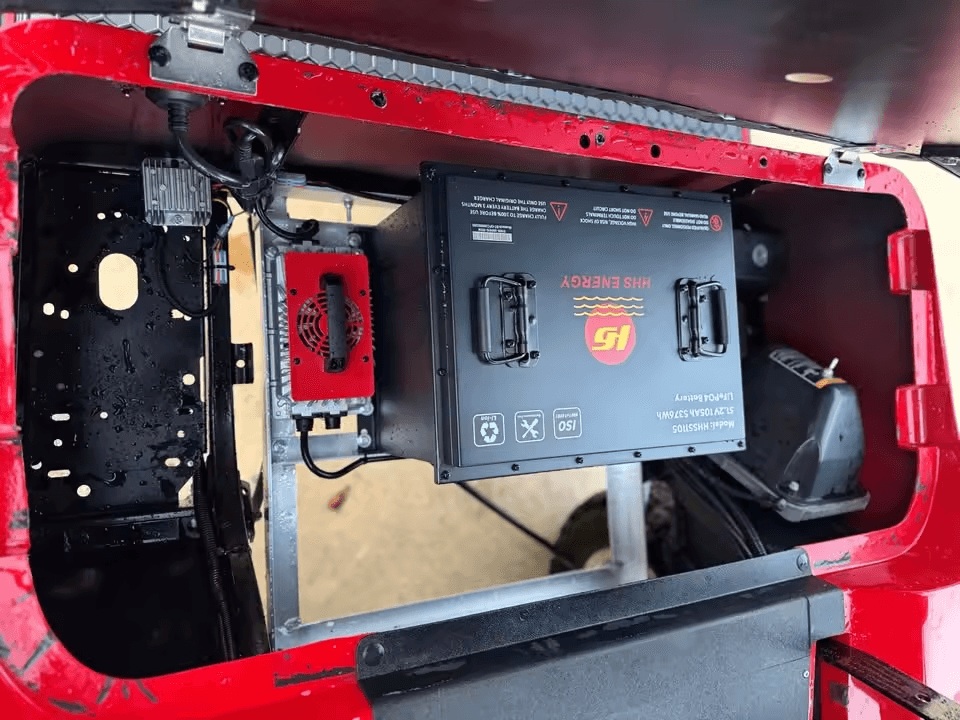
A lithium battery golf cart uses a rechargeable lithium-ion battery pack to supply electrical energy to its motor controller and electric drive motor.
The battery pack is generally made up of multiple individual cells connected in series and, where necessary, parallel configurations.
A typical electric golf cart power system includes:
- Battery cells: Store and release electrical energy.
- Battery Management System (BMS): Monitors battery conditions and manages protection functions.
- Motor controller: Regulates the electrical power delivered to the motor.
- Electric motor: Converts electrical energy into mechanical movement.
- Charger: Recharges the battery using a compatible charging profile.
- Vehicle wiring and protection devices: Connect and protect the electrical system.
The battery voltage and discharge capability must match the requirements of the motor controller and vehicle.
For example, many golf carts use 36V or 48V-class electrical systems. Some lithium replacement batteries are designed with a nominal voltage of 51.2V for compatible 48V-class applications.
A 51.2V battery is commonly configured with 16 LiFePO4 cells connected in series, assuming a nominal cell voltage of 3.2V.
This does not mean every 48V lead-acid golf cart can accept any 51.2V lithium battery. The controller’s operating voltage range, charging voltage, BMS settings, and vehicle manufacturer’s requirements must all be checked before installation.
3. Key Advantages of Lithium Battery Golf Carts
3.1 Longer Service Life and Reduced Replacement Frequency
One of the most important reasons buyers consider lithium batteries is their potential for longer service life.
Traditional lead-acid batteries are affected by discharge depth, maintenance practices, charging habits, temperature, and operating conditions. Repeated deep discharges and incomplete charging can shorten their useful life.
LiFePO4 batteries can generally support more charge-discharge cycles than conventional lead-acid batteries when operated within their specified limits.
The practical benefit is that a lithium battery may need replacement less frequently over the operating life of a golf cart.
This can be particularly valuable for:
- Golf courses operating large cart fleets.
- Resorts using carts for guest transportation.
- Rental businesses with frequent daily use.
- Commercial operators that depend on vehicle availability.
- Residential communities with regularly used shared carts.
However, there is no single lifespan that applies to every lithium battery. Actual service life depends on cell quality, BMS design, temperature, charging conditions, discharge depth, and storage practices.
When comparing products, buyers should ask manufacturers for cycle-life test conditions rather than relying only on a headline cycle-life number.
3.2 More Consistent Power Delivery

Golf cart performance depends on the combined operation of the battery, controller, motor, drivetrain, tires, and vehicle load.
One advantage of many lithium battery systems is their relatively stable discharge voltage over much of the operating range.
With lead-acid batteries, voltage generally declines as the battery discharges. Under heavy acceleration or climbing conditions, voltage drop can affect the available power delivered to the controller.
A properly designed lithium battery system can maintain a more stable voltage during discharge, helping the vehicle deliver more consistent performance.
Potential benefits include:
- More consistent acceleration.
- More predictable power delivery.
- Better performance under suitable load conditions.
- Reduced battery-related voltage sag when the system is correctly designed.
It is important to understand that a lithium battery does not automatically make every golf cart faster or more powerful.
Maximum vehicle speed and acceleration are also controlled by motor specifications, controller programming, drivetrain design, tire size, and manufacturer settings.
The battery’s continuous and peak discharge ratings must also be sufficient for the vehicle’s actual current requirements.
3.3 Lower Battery Weight
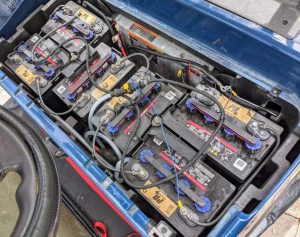
Weight is another important difference between lead-acid and lithium battery systems.
A traditional golf cart may use multiple lead-acid batteries connected in series. The combined battery bank can add considerable weight to the vehicle.
A lithium replacement system can often provide comparable or greater usable energy with a lower battery weight, depending on the specific products being compared.
Reducing battery weight may help improve:
- Vehicle handling.
- Energy efficiency.
- Available payload capacity.
- Acceleration characteristics.
- Ease of battery installation and service.
For fleet operators, lower weight can also be relevant when evaluating vehicle efficiency and operating costs.
However, battery weight is only one part of the vehicle’s total weight. Tire selection, suspension, passenger load, cargo, and chassis design also influence performance.
Before installing a lighter battery, vehicle manufacturers and conversion specialists should confirm that the new battery mounting arrangement is secure and compatible with the vehicle’s weight distribution requirements.
3.4 Faster Charging and Less Downtime
Charging time is especially important for golf courses, rental operators, and commercial fleets.
A vehicle that remains connected to a charger for long periods may be unavailable for the next round, guest transfer, or work shift.
Many lithium battery systems can accept higher charging currents than comparable lead-acid systems, provided the battery cells, BMS, charger, wiring, and connectors are designed for that purpose.
This can reduce charging time and improve vehicle availability.
The actual charging time depends on:
- Battery capacity.
- Initial state of charge.
- Charger output power.
- Maximum permitted charging current.
- BMS charging limits.
- Battery temperature.
- Charging profile and voltage settings.
For example, a 105Ah battery charged at a constant 20A would require approximately 5.25 hours for the idealized bulk-current portion of a full-capacity charge:
105 Ah ÷ 20 A = 5.25 hours
This is a simplified calculation, not a guaranteed full-charge time. Actual charging includes other factors, such as the charging algorithm, current tapering, and losses.
Fleet operators should compare charging systems as a complete package rather than looking only at the battery’s advertised capacity.
3.5 Reduced Routine Maintenance
Traditional flooded lead-acid batteries require periodic maintenance, including checking electrolyte levels and maintaining clean battery terminals.
AGM and gel batteries have different maintenance requirements, but all lead-acid types remain subject to charging and operating limitations.
Lithium battery systems generally require less routine battery maintenance.
A properly designed LiFePO4 battery pack typically does not require users to add water or perform electrolyte maintenance.
Its BMS can also provide protection and monitoring functions, depending on the design.
Nevertheless, low maintenance does not mean maintenance-free operation.
Users should still:
- Inspect battery cables and connectors.
- Check mounting hardware.
- Keep terminals and battery compartments clean and dry.
- Monitor battery status and fault alerts.
- Follow the manufacturer’s charging instructions.
- Arrange professional inspection when faults occur.
3.6 Improved Energy Utilization
Battery capacity is commonly expressed in ampere-hours (Ah), but this figure alone does not show the total energy stored in a battery.
A more useful comparison for many applications is nominal energy, measured in watt-hours (Wh) or kilowatt-hours (kWh).
The calculation is:
Nominal Energy (Wh) = Voltage (V) × Capacity (Ah)
For example:
These figures represent nominal energy, not guaranteed usable energy.
The amount of energy available to the vehicle depends on the battery’s permitted operating range, BMS settings, discharge current, temperature, and system efficiency.
Lithium batteries can often provide a greater usable portion of their nominal capacity than lead-acid batteries under appropriate operating conditions. This is one reason a lithium battery with a similar Ah rating may provide a different practical operating experience.
4. Lithium vs. Lead-Acid Golf Cart Batteries: Which Is Better?
Both battery technologies have advantages. The right choice depends on purchase budget, vehicle requirements, usage frequency, and long-term operating plans.
4.1 When Lead-Acid May Be a Suitable Choice
Lead-acid batteries may remain appropriate for:
- Golf carts with relatively low daily usage.
- Buyers with limited initial budgets.
- Existing fleets with established lead-acid maintenance processes.
- Applications where replacement cost is the main purchasing consideration.
For a vehicle used only occasionally, the higher initial cost of lithium may not always be justified.
4.2 When Lithium May Be the Better Investment
Lithium batteries may be more attractive when:
- Vehicles operate frequently.
- Charging downtime is expensive.
- Lower battery weight is valuable.
- Fleet operators want to reduce routine battery maintenance.
- Long-term operating costs matter more than initial purchase price.
- The vehicle is designed for lithium battery compatibility.
For a commercial golf cart fleet, a lithium battery may offer operational advantages that become more meaningful over several years of use.
5. Are Lithium Battery Golf Carts More Cost-Effective?

Source: solanaev.com
Lithium batteries usually have a higher initial purchase price than comparable lead-acid batteries.
However, comparing only the purchase price can lead to an incomplete buying decision.
A more useful method is to evaluate Total Cost of Ownership (TCO).
5.1 What Should Be Included in TCO?
A golf cart battery cost comparison should include:
- Initial battery purchase price.
- Installation and conversion costs.
- Charger replacement or upgrade costs.
- Electricity consumption.
- Routine maintenance expenses.
- Battery replacement frequency.
- Vehicle downtime.
- Warranty and after-sales support.
A simplified TCO model is:
TCO = Initial Cost + Operating Cost + Maintenance Cost + Replacement Cost
The calculation period should be the same for both battery types.
5.2 Illustrative Example: Lead-Acid vs. Lithium
Consider a golf course comparing two battery options for a fleet vehicle.
Illustrative example only. These figures are hypothetical and are not actual HHS product pricing, test results, or guaranteed service-life data.
In this simplified example, the total costs are similar.
The result could change significantly if the lithium battery lasts longer, electricity costs differ, maintenance expenses increase, or the vehicle is used more frequently.
The correct decision should be based on realistic operating data from the fleet rather than assumptions that lithium is always cheaper.
5.3 Why Downtime Matters for Commercial Fleets
For a private golf cart owner, battery downtime may be inconvenient.
For a golf course or rental business, an unavailable vehicle can affect daily operations and customer service.
A fleet operator should therefore consider not only battery replacement costs but also the financial impact of vehicles being unavailable.
This can make charging speed, battery reliability, service support, and warranty coverage important parts of the purchasing decision.
6. Important Considerations Before Buying a Lithium Golf Cart Battery
Lithium batteries offer several potential benefits, but buyers should check compatibility and safety before upgrading.
6.1 Verify Voltage Compatibility
The replacement battery must match the vehicle’s electrical system requirements.
Common golf cart systems include 36V and 48V configurations. Some lithium batteries use 51.2V nominal voltage for compatible 48V-class applications.
Before purchasing, verify:
- Original battery configuration.
- Controller operating voltage range.
- Battery maximum and minimum voltage.
- Charger output voltage.
- BMS protection settings.
- Vehicle manufacturer’s requirements.
Never assume that two batteries are interchangeable simply because their product descriptions both say “48V.”
6.2 Check Continuous and Peak Discharge Current
A golf cart requires electrical current to accelerate, climb hills, carry passengers, and operate under load.
The battery must be able to supply the required current without triggering BMS protection.
Buyers should compare:
- Continuous discharge current.
- Peak discharge current.
- Permitted peak duration.
- Motor controller current limits.
- BMS overcurrent protection settings.
A battery with sufficient Ah capacity may still be unsuitable if its discharge-current capability is too low.
6.3 Check BMS Protection Functions
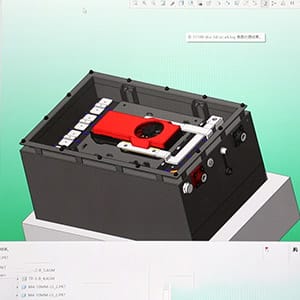
The Battery Management System is one of the most important parts of a lithium golf cart battery.
It monitors battery operating conditions and provides protection according to the system design.
Important functions may include:
- Overcharge protection.
- Over-discharge protection.
- Overcurrent protection.
- Short-circuit protection.
- High- and low-temperature protection.
- Cell voltage monitoring.
- Cell balancing.
Some advanced systems may also support Bluetooth monitoring, CAN communication, GPS functions, or other vehicle integration features.
The appropriate BMS specification depends on the motor controller, battery capacity, operating current, and vehicle requirements.
6.4 Confirm Charger Compatibility
A lithium battery requires a compatible charging profile.
A charger designed for a lead-acid battery should not automatically be used with a lithium replacement.
Before installation, verify:
- Charging voltage.
- Maximum charging current.
- Charging connector and polarity.
- Charging communication requirements.
- BMS charge protection behavior.
- Low-temperature charging restrictions.
Using an incompatible charger can cause charging faults, prevent the battery from reaching full capacity, or create unsafe operating conditions.
6.5 Consider Temperature and Weather Conditions
Battery performance is affected by temperature.
High temperatures can accelerate battery aging, while low temperatures can reduce available power and charging capability.
LiFePO4 batteries generally should not be charged below the minimum temperature specified by their cell manufacturer unless the battery system incorporates an approved low-temperature charging solution.
For golf carts used in cold climates, buyers should ask whether the battery includes:
- Low-temperature charging protection.
- Battery heating, if required.
- Temperature monitoring.
- Appropriate enclosure and installation protection.
These features should be selected according to the actual climate and operating conditions.
6.6 Check Battery Dimensions and Installation
Even when voltage and capacity are suitable, the battery must physically fit the golf cart.
Check:
- Battery compartment dimensions.
- Mounting points.
- Cable length and routing.
- Terminal orientation.
- Ventilation and enclosure requirements.
- Weight distribution.
- Access for inspection and service.
Professional installation is recommended when converting a lead-acid golf cart to lithium.
7. Lithium Golf Cart Batteries for Different Applications
Not every golf cart has the same operating requirements.
The battery should be selected according to the vehicle’s daily workload.
7.1 Golf Course Fleets

Source: c2vehicles.com
Golf course operators may need carts to complete several rounds each day.
Important battery requirements include:
- Sufficient usable energy for the daily schedule.
- Reliable performance under repeated discharge.
- Compatible charging infrastructure.
- Suitable charging time between operating periods.
- Consistent performance on hilly courses.
- Reliable technical and warranty support.
For larger fleets, standardized battery configurations can also simplify maintenance and spare-parts management.
7.2 Resorts and Hotels
Resorts often use golf carts for guest transportation, luggage delivery, housekeeping, and maintenance.
These vehicles may operate throughout the day with frequent stops and starts.
A lithium battery system should therefore be selected based on daily distance, passenger load, terrain, and charging opportunities.
7.3 Residential Communities
Residential golf carts are often used for short trips to shops, community facilities, parks, and nearby destinations.
For these applications, buyers may prioritize:
- Reliable everyday operation.
- Convenient charging.
- Lower routine maintenance.
- Suitable range for typical trips.
- Long-term battery support.
7.4 Utility and Commercial Vehicles

Source: clubcar.com
Utility golf carts may carry tools, equipment, materials, or maintenance supplies.
These vehicles can experience higher loads than passenger golf carts.
Battery selection should consider the maximum vehicle weight, motor current, operating hours, terrain, and required peak power.
A battery designed for a lightly loaded passenger cart may not be suitable for a heavy-duty utility application.
8. What Should Golf Cart Dealers and Manufacturers Look for in a Battery Supplier?
For dealers, distributors, and vehicle manufacturers, battery sourcing is not simply about choosing a product with a competitive price.
A reliable supplier should be able to provide technical information, consistent manufacturing quality, and support for the intended vehicle platform.
8.1 Manufacturing and Quality Control
Evaluate the supplier’s manufacturing capabilities, production controls, traceability, and quality management processes.
Relevant questions include:
- Does the supplier manufacture battery packs in-house?
- Are battery cells inspected and matched?
- Are pack assembly processes controlled?
- Is production traceability available?
- Are finished products tested before shipment?
- Can the supplier provide relevant test reports?
8.2 Product Customization
Different golf cart platforms may require different battery dimensions, connectors, communication protocols, and discharge ratings.
An OEM/ODM battery supplier should be able to evaluate requirements such as:
- Battery voltage and capacity.
- Battery enclosure dimensions.
- Continuous and peak current.
- BMS functions.
- Charger compatibility.
- Communication requirements.
- Environmental operating conditions.
8.3 Certifications and Transportation Documentation
Battery buyers should request documentation applicable to the product and target market.
Depending on the product and destination, relevant documentation may include:
- UN38.3 test summary.
- Safety test reports.
- Applicable CE documentation.
- SDS or MSDS.
- Other market-specific compliance documents.
Do not assume that every battery model from a manufacturer has the same certifications. Verify the documentation for the specific model and configuration being purchased.
8.4 Warranty and After-Sales Support
Warranty terms should clearly explain:
- Warranty duration.
- Coverage conditions.
- Capacity or performance criteria, if applicable.
- Exclusions and operating limitations.
- Technical support procedures.
- Replacement and service processes.
For commercial fleets, supplier response time and access to technical support can be just as important as the original battery price.
9. Why LiFePO4 Is an Important Option for Modern Golf Cart Battery Systems
Lithium-ion batteries include several different chemistries. They should not all be treated as identical.
LiFePO4 is particularly relevant to golf cart applications because it combines useful energy characteristics with good thermal stability and cycle-life potential.
For vehicle manufacturers and fleet operators, the battery pack should be engineered around the actual electrical and mechanical requirements of the vehicle.
HHS Golf Energy provides LiFePO4 battery solutions for golf cart applications, including 51.2V 105Ah battery systems.
For golf cart dealers, distributors, and manufacturers, important design considerations include battery capacity, discharge performance, BMS protection, charger compatibility, installation dimensions, and communication requirements.
OEM and ODM development can help adapt battery packs to different golf cart platforms and commercial operating conditions.
The right solution should be selected through technical evaluation rather than relying on voltage and capacity labels alone.
10. Frequently Asked Questions About Lithium Battery Golf Carts
Conclusion
The growing adoption of lithium battery golf carts reflects changing expectations across golf courses, residential communities, resorts, and commercial fleets.
Compared with traditional lead-acid systems, lithium batteries can offer several practical advantages, including lower weight, more consistent power delivery, faster charging capability, reduced routine maintenance, and longer cycle-life potential.
However, the benefits depend on the complete battery and vehicle system. Voltage compatibility, BMS protection, discharge current, charger specifications, temperature limits, and installation requirements must all be considered before purchasing or upgrading.
For golf cart owners, the right battery can improve everyday usability. For dealers, fleet operators, and manufacturers, choosing a reliable battery supplier can also help support long-term operating efficiency and product quality.
As lithium technology continues to develop, LiFePO4 battery systems are likely to remain an important option for the next generation of electric golf carts.
Need a lithium battery solution for your golf cart?
HHS Golf Energy provides custom LiFePO₄ battery packs for golf carts, utility vehicles, and commercial fleets. We help you match voltage, capacity, BMS, charger, and communication to your specific vehicle platform.
HHS Golf Energy — Lithium Battery Solutions for Golf Carts & Electric Vehicles
© 2026 HHS Golf Energy | Smart Battery Technology