The Complete Guide to NEVs, LSVs, Micro-Cars & Golf Carts: Differences, Regulations, Uses, and Battery Technology in 2026
Small electric vehicles are becoming an increasingly visible part of modern transportation. From neighborhood trips and resort transportation to golf courses, retirement communities, commercial properties, and urban mobility, compact electric vehicles offer an alternative to conventional passenger cars for shorter journeys.
However, terms such as Neighborhood Electric Vehicle (NEV), Low-Speed Vehicle (LSV), micro-car, and golf cart are often used interchangeably in marketing materials. This can create confusion for buyers, dealers, fleet operators, and manufacturers.
Although these vehicles may look similar, they can have very different legal classifications, safety requirements, performance capabilities, and permitted operating environments.
For example, a conventional golf cart designed for golf course transportation is not automatically a street-legal LSV. Similarly, a micro-car capable of traveling faster than 25 mph may fall under a different federal vehicle classification and face substantially different compliance requirements.
This guide explains the differences between NEVs, LSVs, micro-cars, and golf carts, including their technical characteristics, applications, US regulatory considerations, and battery requirements.
1. What Are NEVs, LSVs, Micro-Cars, and Golf Carts?
Before comparing these vehicles, it is important to understand what each term means.
1.1 What Is a Neighborhood Electric Vehicle (NEV)?

Source: clion-ev.en.made-in-china.com
A Neighborhood Electric Vehicle, commonly called an NEV, is a compact electric vehicle designed primarily for short-distance transportation in residential neighborhoods, planned communities, resorts, campuses, and other low-speed environments.
In the United States, NEV is commonly used as a market term for electric vehicles that meet the federal Low-Speed Vehicle classification. Under this framework, the vehicle must have:
- Four wheels.
- A maximum speed greater than 20 mph but not greater than 25 mph.
- A gross vehicle weight rating (GVWR) below 3,000 pounds.
- Compliance with applicable federal low-speed vehicle safety requirements.
NEVs typically feature a steering wheel, accelerator and brake pedals, passenger seating, headlights, turn signals, mirrors, seat belts, and other road-use equipment. Unlike conventional golf carts, NEVs are designed and certified for qualifying public-road use, subject to state and local restrictions.
Common applications include:
- Residential neighborhoods.
- Retirement communities.
- Resorts and hotels.
- University campuses.
- Large commercial properties.
- Short-distance community transportation.
1.2 What Is a Low-Speed Vehicle (LSV)?

Source: tularepolaris.com
A Low-Speed Vehicle, or LSV, is a federally recognized motor vehicle category in the United States. According to the federal definition, an LSV is a four-wheeled motor vehicle with a speed capability of more than 20 mph and no more than 25 mph, and a GVWR below 3,000 pounds.
LSVs must comply with Federal Motor Vehicle Safety Standard (FMVSS) No. 500. This standard specifies minimum safety equipment, including:
- Headlamps.
- Front and rear turn signal lamps.
- Taillamps and stop lamps.
- Reflex reflectors.
- Parking brake.
- Exterior and/or interior mirrors.
- Compliant windshield glazing.
- Seat belts.
- Vehicle Identification Number (VIN).
- Rear visibility system.
The exact equipment requirements should be checked against the applicable version of the federal standard.
An important distinction is that LSV is the federal regulatory category, while NEV is commonly used as a market or consumer-facing term. Many vehicles marketed as NEVs are legally classified as LSVs. However, the two terms should not be assumed to be legally identical in every state or market.
1.3 What Is a Micro-Car?

Source: menila-gmbh.de
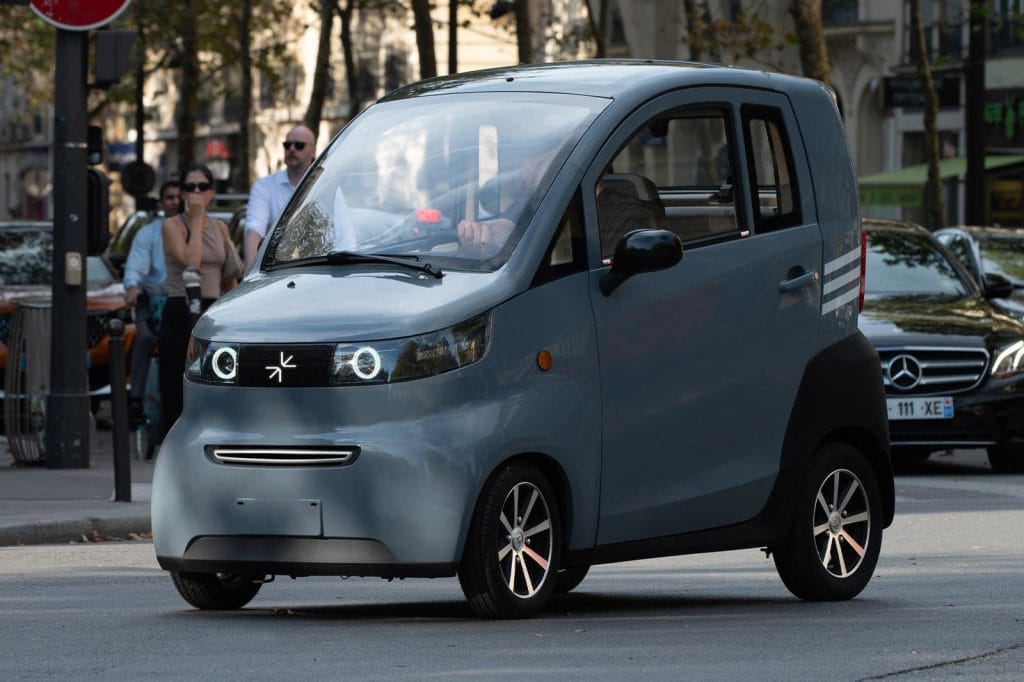
A micro-car is a general descriptive term for a very small passenger vehicle. Unlike LSV, micro-car is not one single federal vehicle classification in the United States. It can describe different types of compact vehicles depending on their design, maximum speed, weight, powertrain, and intended use.
Micro-cars may include:
- Small enclosed electric city cars.
- Two-seat urban electric vehicles.
- Compact four-wheel passenger vehicles.
- Low-speed enclosed neighborhood vehicles.
- Small vehicles designed for narrow streets and short urban journeys.
Some micro-cars may qualify as LSVs if they meet the applicable federal definition and certification requirements. Others may be classified as passenger cars or another type of motor vehicle.
For example, an enclosed electric vehicle capable of traveling at 35 mph does not qualify as an LSV under the federal 25 mph maximum-speed definition. Its manufacturer must determine the applicable federal vehicle category and comply with the corresponding safety standards. This is why buyers should evaluate a micro-car’s actual certification rather than relying on its size or marketing description.
1.4 What Is a Golf Cart?

Source: cadyro.com
A golf cart is a small vehicle originally designed for transporting golfers and golf equipment around golf courses. Traditional golf carts are usually electric or gasoline-powered and typically operate at lower speeds than road-certified LSVs.
Common characteristics include:
- Two, four, or six passenger configurations.
- Open or partially enclosed seating.
- Compact dimensions.
- Simple controls.
- Low-speed operation.
- Electric or gasoline powertrains.
Golf carts are widely used on golf courses, private properties, resorts, industrial facilities, and other controlled environments. Some golf carts can be used on public roads under specific state and local laws. However, this does not mean every golf cart is an LSV or automatically qualifies for street-legal operation. A conventional golf cart may need substantial modifications and, where legally permitted, an appropriate certification or vehicle classification before it can be used on public roads.
2. NEV vs. LSV vs. Micro-Car vs. Golf Cart: Key Differences
The following table summarizes the main differences.
Note: The table distinguishes common market descriptions from federal vehicle classifications. Actual specifications and legal status depend on the individual vehicle.
2.1 Speed and Performance
Speed is one of the most noticeable differences between these vehicle types. Traditional golf carts generally operate at lower speeds, while federally classified LSVs are designed to travel faster than 20 mph but no more than 25 mph. Micro-cars have a much wider performance range. Some are designed for low-speed transportation, while others are capable of higher urban or highway speeds.
A vehicle’s advertised maximum speed alone does not establish its legal classification. The federal definition considers speed capability under specified test conditions, together with wheel count and GVWR.
2.2 Safety Equipment
Golf carts are generally designed around low-speed operation in controlled environments. Their equipment may be relatively basic. LSVs require specific safety equipment under FMVSS No. 500 because they are intended for qualifying public-road use. Micro-cars may have more extensive safety systems, depending on their regulatory classification.
For buyers, the key question is not simply whether a vehicle has headlights, mirrors, or seat belts. It is whether the complete vehicle has been manufactured and certified to meet the applicable requirements.
2.3 Comfort and Vehicle Design
Vehicle design also varies significantly. Traditional golf carts prioritize easy access, maneuverability, and passenger convenience. Many use open seating and simple weather protection. NEVs and LSVs may have more road-oriented designs, including enclosed cabins, windshields, doors, lighting systems, and automotive-style controls. Micro-cars often emphasize compact dimensions and enclosed passenger space, making them more suitable for urban environments and weather protection.
3. Where Can These Vehicles Be Driven in the United States?

Source: clubcar.com
Road access is one of the most important considerations when purchasing a small electric vehicle. A vehicle’s federal classification and its permitted road use are two separate issues. Federal regulations establish vehicle classification and manufacturing requirements. State and local laws determine where a qualifying vehicle may be operated, including registration, licensing, road-speed restrictions, and local authorization.
3.1 Where Can LSVs Be Driven?
In general, LSVs are intended for roads with speed limits of 35 mph or less, subject to applicable state and local laws. Some jurisdictions impose additional restrictions, including:
- Driver licensing requirements.
- Vehicle registration and insurance.
- Minimum equipment requirements.
- Restrictions on crossing higher-speed roads.
- Local roadway designation requirements.
LSVs are generally not permitted on interstate highways or other roads where their low maximum speed would create an unsafe traffic environment.
3.2 Where Can NEVs Be Driven?
NEVs that meet the applicable LSV requirements generally follow the same road-access framework as LSVs. However, individual state definitions and local ordinances may affect how NEVs are registered and operated. Before purchasing an NEV for community transportation, fleet use, or personal travel, buyers should confirm the regulations in the intended operating location.
3.3 Where Can Golf Carts Be Driven?
Golf cart road access varies considerably by state and local jurisdiction. Some communities allow golf carts on designated streets, usually with speed-limit restrictions and additional operating conditions. Other areas restrict them to golf courses, private property, or designated routes. A golf cart that is permitted to operate on a particular public road under a state-specific exception is not necessarily federally classified as an LSV.
3.4 What About Micro-Cars?
Micro-cars do not have one universal road-access rule. Their permitted use depends on their actual federal vehicle classification and applicable state laws. A micro-car certified as a passenger car may be subject to substantially different registration, insurance, safety, and road-use requirements from an LSV.
Important: Always verify the vehicle’s certification label, VIN, manufacturer documentation, and local registration requirements before purchasing it for public-road use.
4. NEV, LSV, Micro-Car, and Golf Cart Applications
Different vehicle types serve different transportation needs.


4.1 Golf Courses
Golf courses remain one of the largest traditional applications for golf carts. Golf carts are used to transport golfers, equipment, maintenance personnel, and supplies. Important purchasing considerations include:
- Battery capacity and operating range.
- Passenger and cargo capacity.
- Charging time.
- Battery cycle life.
- Terrain and hill-climbing requirements.
- Maintenance costs.
For commercial golf course operators, battery reliability and predictable daily operating performance are particularly important.
4.2 Residential Communities
NEVs and LSVs are commonly used in planned communities, retirement communities, and residential developments. They provide a convenient option for short trips to:
- Community facilities.
- Shopping areas.
- Restaurants.
- Parks.
- Nearby residential streets.
For these applications, buyers should prioritize road certification, passenger protection, range, and charging convenience.
4.3 Resorts and Hotels
Resorts often use small electric vehicles for guest transportation, housekeeping, luggage delivery, and property maintenance. Golf carts and utility vehicles are particularly useful because of their maneuverability and flexible seating configurations. Larger resorts may operate different vehicle types for different tasks rather than relying on a single model.
4.4 Commercial and Industrial Properties
Factories, warehouses, airports, campuses, and large commercial properties may use electric utility carts to move workers, tools, and materials. For these applications, payload capacity, motor performance, battery capacity, and durability are important selection criteria.
4.5 Urban Short-Distance Transportation
Micro-cars and enclosed NEVs can be useful for short urban journeys. Their compact dimensions may make parking and maneuvering easier than with conventional passenger cars. However, buyers must consider the vehicle’s actual road certification and whether its speed capability is suitable for the intended traffic environment.
5. Battery Technology: What Powers These Small Electric Vehicles?
Battery technology is a major factor affecting the operating cost, range, charging requirements, and performance of electric golf carts, NEVs, and micro-cars. Two commonly used battery technologies are lead-acid and lithium-ion.
5.1 Lead-Acid Batteries
Lead-acid batteries have been used in golf carts and other low-speed electric vehicles for many years. Common types include:
- Flooded lead-acid batteries.
- AGM batteries.
- Gel batteries.
Advantages include established supply chains, relatively low initial purchase costs, and familiarity among vehicle service providers. However, lead-acid batteries are relatively heavy and may require regular maintenance depending on the battery type. Their usable capacity can also be affected by discharge depth, operating temperature, and discharge rate.
5.2 Lithium-Ion Batteries
Lithium-ion batteries are increasingly used in electric golf carts and other compact electric vehicles. Compared with traditional lead-acid batteries, properly designed lithium battery systems can offer:
- Lower weight for comparable usable energy.
- Higher usable capacity.
- Faster charging capability when supported by the battery and charger.
- More stable voltage during discharge.
- Lower routine maintenance requirements.
- Integrated Battery Management Systems.
The actual performance depends on cell chemistry, battery configuration, BMS design, thermal management, and vehicle operating conditions.
5.3 Why LiFePO4 Is Popular in Golf Carts and Low-Speed Vehicles
Lithium Iron Phosphate (LiFePO4 or LFP) is a lithium-ion chemistry widely used in low-speed electric vehicles and energy storage applications. Its characteristics include:
- Good thermal stability compared with some other lithium-ion chemistries.
- Long cycle-life potential under suitable operating conditions.
- Stable discharge characteristics.
- No cobalt in its cathode chemistry.
- Suitability for repeated charging and discharging.
For golf cart and utility vehicle applications, LiFePO4 can be an attractive option where battery weight, operating life, and daily charging requirements are important. Nevertheless, battery selection must be based on the complete vehicle system rather than chemistry alone.
5.4 Lead-Acid vs. Lithium Battery Comparison
The actual lifespan and operating cost depend on battery quality, charging practices, temperature, depth of discharge, and maintenance.
6. How to Choose the Right Battery for an NEV, LSV, or Golf Cart
The correct battery is not necessarily the one with the highest capacity or the lowest purchase price. It must match the vehicle’s electrical system and operating requirements.
6.1 Check the System Voltage
Common golf cart and low-speed vehicle battery system voltages include:
- 36V.
- 48V.
- 51.2V nominal LiFePO4 systems.
- Other configurations depending on vehicle design.
A 51.2V LiFePO4 battery is commonly designed as a 16-series-cell configuration using cells with a nominal voltage of approximately 3.2V. However, a nominal voltage match does not guarantee compatibility. The controller, charger, wiring, battery protection settings, and vehicle operating voltage range must all be checked.
6.2 Calculate the Required Battery Capacity
Battery energy can be estimated using:
Energy (Wh) = Voltage (V) × Capacity (Ah)
For example, a 51.2V 105Ah battery has a nominal energy rating of: 51.2 × 105 = 5,376 Wh. This equals approximately 5.38kWh.
Actual usable energy will depend on the battery’s operating limits and BMS settings. Vehicle energy consumption also varies according to passenger load, terrain, speed, tire pressure, driving style, and temperature.
6.3 Evaluate BMS Performance
The Battery Management System is essential for protecting lithium battery packs. Important BMS functions include:
- Overcharge protection.
- Over-discharge protection.
- Overcurrent protection.
- Short-circuit protection.
- Temperature monitoring.
- Cell balancing.
- Communication with the vehicle or charger, where required.
For commercial applications, additional functions such as Bluetooth monitoring, CAN communication, GPS integration, and battery heating may be useful depending on the vehicle design.
6.4 Consider Charging Compatibility
A lithium battery should use a charger with a compatible charging profile. A lead-acid charger should not automatically be assumed suitable for a lithium battery conversion. The battery manufacturer and vehicle integrator should verify:
- Charging voltage.
- Maximum charging current.
- Charging communication requirements.
- BMS charge-disconnection behavior.
- Low-temperature charging protection.
- Connector and wiring compatibility.
6.5 Consider Operating Temperature
Temperature affects battery charging, discharging, and service life. LiFePO4 batteries generally require protection against charging below the cell manufacturer’s permitted temperature range. Some battery systems incorporate low-temperature charge protection or an integrated heater. For vehicles used outdoors in cold climates, this should be part of the battery specification rather than an afterthought.
7. What Should Dealers and Fleet Operators Consider Before Buying?
Choosing between an NEV, LSV, micro-car, and golf cart requires more than comparing purchase prices. A practical evaluation should include the following factors.
7.1 Evaluate Total Cost of Ownership
The initial vehicle price is only one part of the total cost. A more complete calculation includes:
- Vehicle purchase price.
- Battery purchase or replacement cost.
- Electricity consumption.
- Charging equipment.
- Routine maintenance.
- Tire and brake replacement.
- Insurance and registration where applicable.
- Downtime and service expenses.
For commercial fleets, operating reliability and battery replacement intervals can have a major influence on long-term costs.
7.2 Match the Vehicle to the Operating Environment
A golf course may prioritize maneuverability and passenger comfort. A residential community may need certified road-use vehicles. A hotel may require a combination of passenger and utility carts. An urban mobility operator may need enclosed vehicles with a different regulatory classification. The best choice depends on the actual job the vehicle needs to perform.
8. The Role of Battery Manufacturers in the Small Electric Vehicle Market
As electric golf carts, NEVs, LSVs, and compact utility vehicles become more widely used, battery system design is an important part of vehicle development. Vehicle manufacturers and fleet equipment suppliers may require different battery configurations based on vehicle voltage, motor power, operating range, charging time, and environmental conditions.
For example, a golf cart designed for daily resort operation may have different battery requirements from a compact utility vehicle used for industrial material handling. A suitable battery solution should be developed around:
- Required voltage and capacity.
- Continuous and peak discharge current.
- Charging current and charging profile.
- BMS protection and communication.
- Installation dimensions.
- Thermal and environmental conditions.
- Expected daily operating cycles.
HHS Golf Energy focuses on lithium battery solutions for golf cart applications, including 51.2V LiFePO4 battery systems. For vehicle manufacturers, distributors, and commercial buyers, battery configuration and system compatibility should be evaluated according to the specific vehicle platform and operating requirements.
OEM and ODM battery development can help manufacturers adapt battery packs to different installation spaces, electrical architectures, and application requirements.
9. Future Trends in NEVs, LSVs, Micro-Cars, and Golf Carts
The market for compact electric vehicles continues to evolve as manufacturers respond to changing transportation needs. Several trends are worth watching.
9.1 Greater Adoption of Lithium Battery Systems
Lithium batteries are becoming increasingly relevant to golf carts and other compact electric vehicles. Their potential advantages in weight, usable energy, and charging flexibility make them attractive for applications involving frequent daily use.
9.2 More Advanced Battery Management
Modern battery systems increasingly incorporate monitoring and communication functions. Bluetooth, CAN communication, temperature monitoring, and integrated protection systems can help vehicle manufacturers improve system integration and maintenance.
9.3 More Enclosed and Comfortable Vehicles
Some consumers want the convenience of a golf cart with greater weather protection and passenger comfort. This is contributing to interest in enclosed neighborhood vehicles and compact electric micro-cars.
9.4 More Specialized Commercial Vehicles
Rather than using one vehicle for every task, commercial operators may adopt specialized configurations for passenger transportation, maintenance, luggage delivery, and cargo handling. This creates demand for different battery capacities, discharge ratings, and installation configurations.
9.5 Greater Attention to Compliance
As small electric vehicles become more visible on public roads, manufacturers and distributors need to pay close attention to federal vehicle classifications, certification, and state-level operating requirements. Vehicle appearance and marketing descriptions are not substitutes for regulatory compliance.
10. Frequently Asked Questions
Conclusion
NEVs, LSVs, micro-cars, and golf carts all serve important roles in short-distance transportation, but they are not interchangeable vehicle categories.
NEVs and LSVs are closely related terms in the US market, with LSV representing a formal federal vehicle classification. Micro-cars cover a broader range of compact vehicles, while conventional golf carts are primarily designed for golf courses and controlled environments.
For buyers, the most important considerations are vehicle certification, road-use regulations, passenger capacity, operating range, safety equipment, and total ownership cost.
Battery technology is another major factor, particularly for electric golf carts and commercial low-speed vehicles. A properly engineered lithium battery system can help support vehicle performance, operating efficiency, and long-term fleet requirements.
For golf cart manufacturers, dealers, and fleet operators, selecting the right battery supplier is an important part of building a reliable electric vehicle solution.
Need a battery solution for your NEV, LSV, or golf cart?
HHS Energy provides custom LiFePO₄ battery packs for golf carts, LSVs, NEVs, and utility vehicles. We help you match voltage, capacity, BMS, charger, and communication to your specific vehicle platform.
HHS Energy — Lithium Battery Solutions for Golf Carts & Electric Vehicles
© 2026 HHS Energy | Smart Battery Technology