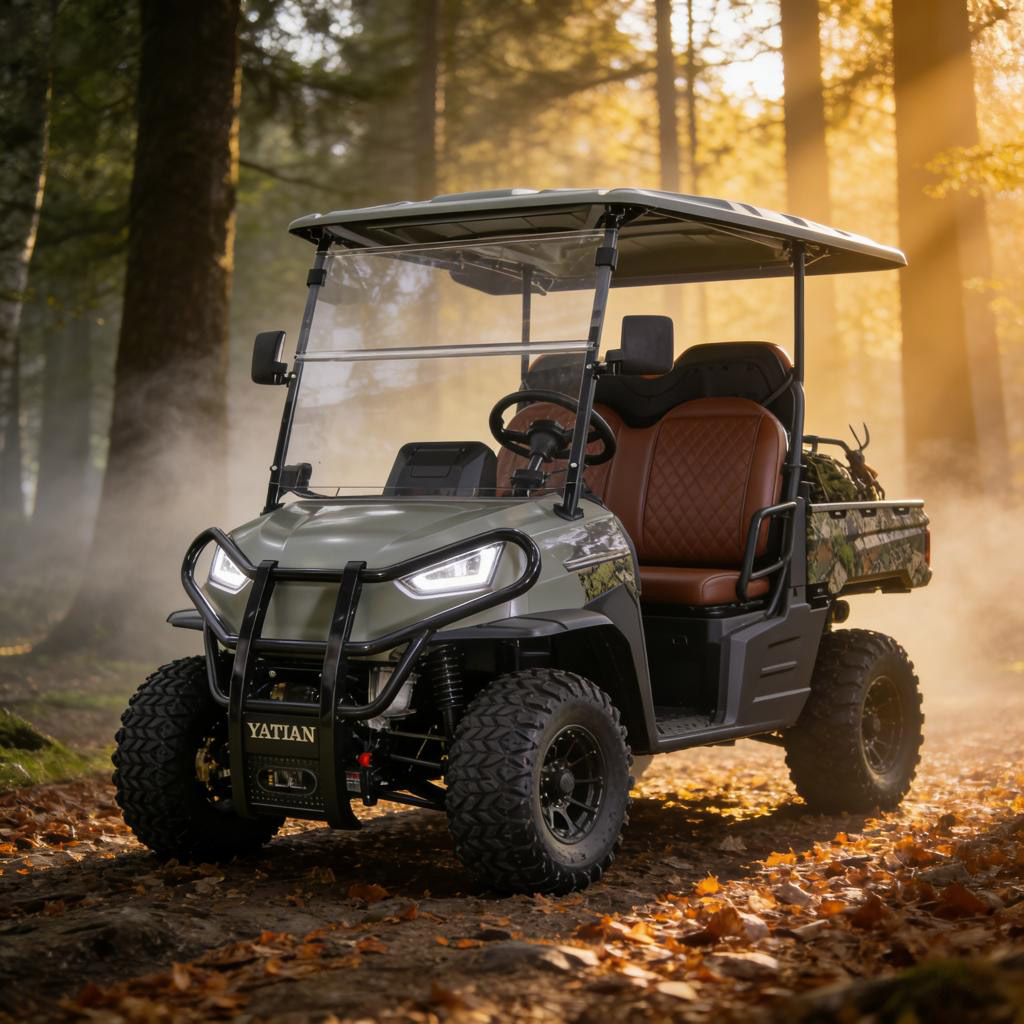
Electric Golf Carts for Hunting and Outdoor Adventures: Off-Road Buying Guide
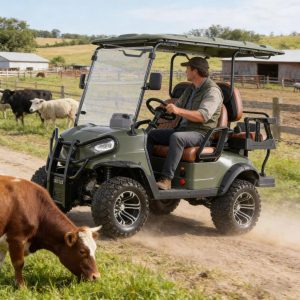
Electric golf carts are no longer limited to golf courses. With the right tires, suspension, ground clearance, battery capacity, and cargo configuration, they can serve as practical transportation vehicles for hunting properties, farms, campgrounds, private trails, and other outdoor environments.
For hunters and outdoor enthusiasts, an electric golf cart can make it easier to transport equipment, move across private property, carry supplies, and travel between hunting locations without the noise and exhaust associated with gasoline-powered vehicles. However, not every golf cart is designed for rough terrain. Choosing the right model requires careful consideration of off-road capability, payload, driving range, battery performance, and terrain conditions.
This guide explains what to look for in an electric hunting golf cart, how off-road electric vehicles differ from standard golf carts, and how to select a battery system for demanding outdoor applications. It is also designed to help golf cart dealers, outdoor vehicle distributors, importers, and private-label brands understand the requirements of this growing product category.
What Is an Electric Hunting Golf Cart?
An electric hunting golf cart is an electric-powered cart adapted for outdoor activities, particularly hunting, wildlife property management, camping, and transportation across private land.
Compared with a standard golf course cart, an outdoor-oriented model may feature:
- All-terrain or off-road tires.
- Increased ground clearance.
- Upgraded suspension.
- A larger battery or higher-capacity battery system.
- Cargo beds, racks, or equipment storage.
- Front and rear utility accessories.
- Weather protection or a roof.
- Lighting for low-light operation.
- Optional winches or other utility equipment, where supported by the vehicle design.
These features allow a cart to handle more varied environments than a typical course vehicle, although its actual capabilities depend on the chassis, drivetrain, tires, suspension, and manufacturer specifications.
An important distinction is that an off-road golf cart is not automatically an all-terrain vehicle or a road-legal low-speed vehicle. Its permitted use depends on its design and the applicable regulations.
Why Choose an Electric Golf Cart for Hunting?
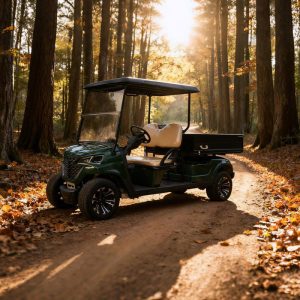
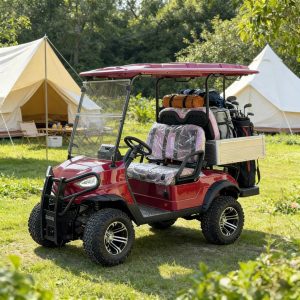
Electric golf carts offer several potential advantages for hunting and outdoor activities. Their suitability depends on the property, terrain, vehicle configuration, and local rules.
1. Quieter operation
Electric motors generally operate more quietly than gasoline engines, especially when a vehicle is moving at low speed. This can be useful when traveling around private property, hunting lodges, or outdoor recreation areas.
However, quiet operation does not make an electric cart completely silent. Tire noise, suspension movement, cargo rattling, and other mechanical sounds can still be noticeable.
2. Convenient equipment transportation
Hunting and outdoor activities often require equipment that is bulky or heavy. A suitably equipped electric cart can transport items such as:
- Hunting packs and clothing.
- Coolers and food supplies.
- Camping equipment.
- Tools and maintenance supplies.
- Decoys and other hunting accessories.
- Recovery equipment and general outdoor gear.
Before loading the vehicle, verify its rated payload and cargo-bed capacity. Accessories and passengers also contribute to the total vehicle load.
3. No exhaust emissions during operation
An electric cart produces no tailpipe exhaust while driving. This can be beneficial when operating around cabins, barns, covered facilities, and other areas where local exhaust emissions are undesirable.
The vehicle still requires electricity for charging, and its overall environmental impact depends on battery production, electricity generation, vehicle use, and battery recycling.
4. Lower routine powertrain maintenance
Electric carts do not require gasoline engine oil changes, spark plug replacement, or fuel-system maintenance. They still need regular inspections of brakes, tires, steering, suspension, electrical connections, and battery systems.
For commercial fleets, reduced routine powertrain maintenance may simplify service scheduling, although total maintenance costs depend on vehicle design and operating conditions.
5. Flexible configurations
Outdoor users have different needs. A hunting property may require cargo capacity and all-terrain tires, while a campground may prioritize passenger seating, weather protection, and driving range. Electric golf cart platforms can be configured for different applications, provided the selected components are compatible with the vehicle and its rated limits.
Standard Golf Cart vs. Off-Road Hunting Golf Cart
Not every electric golf cart is suitable for rough trails. Understanding the difference between a standard course model and an off-road-oriented model is an important first step.
Four-wheel drive is not a universal feature of off-road golf carts. Many lifted carts remain two-wheel-drive vehicles. Buyers should confirm the actual drivetrain rather than assuming that aggressive tires or a raised suspension mean the vehicle can handle every terrain type.
Key Features to Look for in an Off-Road Electric Hunting Cart
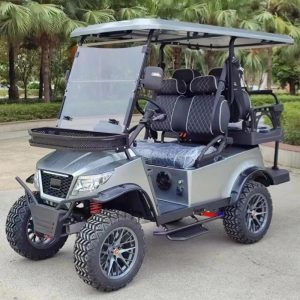
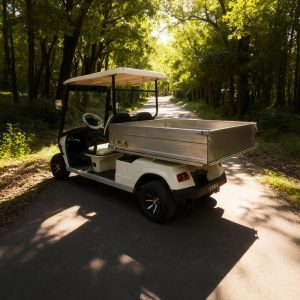
1. All-terrain tires
Tires are one of the most important factors affecting off-road performance. All-terrain tires may provide better traction on dirt, gravel, and uneven paths than turf tires. The correct tire depends on the surface, vehicle weight, and expected operating conditions.
When choosing tires, consider:
- Tread pattern.
- Tire diameter.
- Load rating.
- Compatibility with the wheels.
- Clearance around the body and suspension.
- Effects on acceleration and range.
Larger tires can increase ground clearance, but they can also increase rolling resistance and place additional demands on the motor and drivetrain.
2. Ground clearance and suspension
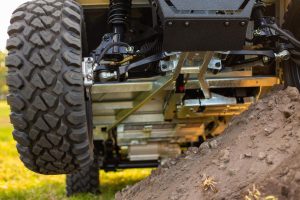
Ground clearance affects whether the vehicle can pass over roots, rocks, ruts, and other obstacles without striking the underside. A lifted golf cart may provide additional clearance, but a lift kit alone does not make a vehicle suitable for severe off-road terrain. The suspension, frame, steering, brakes, tires, and overall chassis must all be appropriate for the intended conditions.
3. Motor torque and drivetrain
Hunting properties can include hills, loose soil, muddy sections, and uneven ground. These conditions can demand more torque than smooth golf course paths.
Buyers should examine:
- Motor rating.
- Controller current limits.
- Gear reduction.
- Drivetrain configuration.
- Rated climbing capability.
- Payload capacity.
- Manufacturer restrictions.
A higher motor power rating does not automatically guarantee better off-road performance. The complete drivetrain must work together, and the vehicle should be operated within its rated limits.
4. Cargo capacity and storage
A hunting cart may carry several passengers, outdoor equipment, tools, and other supplies. This makes payload capacity particularly important. Look for a configuration that provides adequate room for the intended load without exceeding the vehicle’s limits. Potential features include rear cargo beds, storage compartments, racks, and tie-down points. Any modification should preserve safe weight distribution and avoid obstructing lights, steering, or visibility.
5. Lighting and weather protection
Outdoor activities may begin early or continue after sunset. Appropriate lighting can improve visibility when operating in permitted conditions. A roof, windshield, weather enclosure, or protective seat covering may also improve comfort in changing weather. Lighting and weather accessories should be compatible with the vehicle’s electrical system. Buyers should also distinguish between equipment suitable for private property and the additional equipment or certification that may be required for public-road use.
Choosing the Right Battery for an Electric Hunting Golf Cart
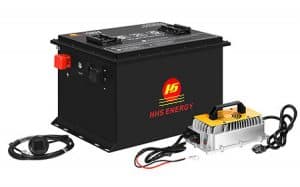
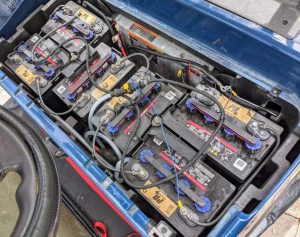
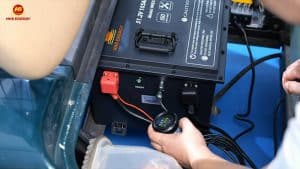
Battery selection is especially important for outdoor electric vehicles because terrain, payload, temperature, and accessory usage can substantially affect energy consumption. A cart used for short trips on flat ground may have very different battery requirements from one that carries heavy loads over hilly trails for several hours.
Lead-acid vs. lithium batteries
Both lead-acid and lithium batteries are used in electric golf carts. Each has advantages and limitations.
Lithium batteries can be attractive for outdoor carts because reducing battery weight may help increase available payload and improve vehicle efficiency. However, the result depends on the complete vehicle configuration. A lithium conversion must account for the charger, controller, battery compartment, current requirements, and any vehicle communication or regenerative braking functions.
How much battery capacity does a hunting cart need?
Battery capacity should be selected according to expected daily use rather than vehicle appearance alone. Consider the following questions:
- How many hours will the cart operate each day?
- How far will it travel?
- Will it climb hills or travel on loose surfaces?
- How many passengers and how much cargo will it carry?
- Will lights, refrigerators, radios, winches, or other accessories be used?
- How much charging time is available between operating periods?
The battery’s nominal energy can be estimated using voltage and amp-hour capacity:
Nominal Energy (Wh) = Voltage (V) × Capacity (Ah)
For example, a 51.2V, 105Ah lithium battery has a nominal energy rating of approximately 5.38kWh. This figure is useful for comparing battery specifications, but it does not directly predict driving range. Actual range depends on vehicle efficiency, terrain, speed, load, temperature, battery limits, and accessory consumption.
Why BMS performance matters
A lithium battery’s Battery Management System (BMS) monitors important operating conditions and provides protection against defined faults. For off-road applications, buyers should pay particular attention to:
- Continuous discharge current.
- Peak discharge current and its permitted duration.
- Over-current protection.
- Over-temperature protection.
- Low-temperature charging protection.
- Cell balancing.
- State-of-charge monitoring.
- Communication compatibility, where required.
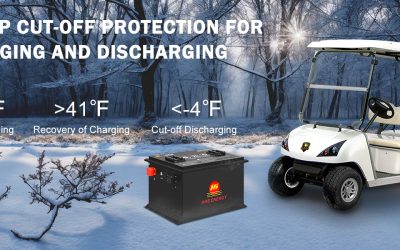
A cart may require substantial current during acceleration or hill climbing. The battery must therefore support the controller’s actual current demands, not just provide enough amp-hour capacity for the expected driving time. For vehicles used in cold climates, verify the battery’s permitted charging temperature. Some LiFePO₄ batteries incorporate low-temperature charging protection or a heating function, while others require different operating procedures.
How to Estimate the Driving Range of an Electric Hunting Cart
Driving range is one of the most important buying considerations for hunters and outdoor users. However, manufacturers’ range figures are not always directly comparable. Tests may use different speeds, loads, temperatures, terrain, and battery configurations.
A practical estimate begins with the battery’s usable energy and the vehicle’s expected energy consumption.
Estimated Range (miles) = Usable Battery Energy (kWh) ÷ Energy Consumption (kWh/mile)
For illustration, if a battery provides 4.5kWh of usable energy and the vehicle consumes 0.15kWh per mile under the intended operating conditions, the calculated range would be 30 miles. This is a mathematical example, not a guaranteed range for a particular cart. Real-world consumption may differ significantly on steep, muddy, sandy, or uneven terrain.
Factors that reduce driving range
- Steep climbs.
- Soft or muddy ground.
- Low tire pressure.
- Heavy cargo.
- Additional passengers.
- High driving speeds.
- Cold temperatures.
- Frequent acceleration and stopping.
- Power-hungry accessories.
- Battery aging.
For hunting and outdoor operations, it is sensible to plan a reserve rather than assuming the vehicle will achieve its best-case advertised range.
Where Can Off-Road Electric Golf Carts Be Used?
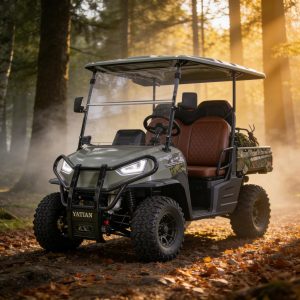
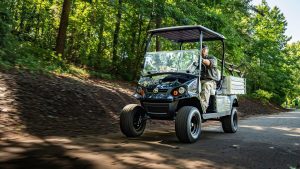
Hunting properties and private land
Electric carts can transport hunters and equipment across suitable private roads and trails. The vehicle must match the terrain, and operators should follow property rules and hunting regulations. Quiet operation may be useful in some settings, but it does not eliminate the need to follow safe operating practices or wildlife management rules.
Farms and ranches
Electric utility carts can support routine property inspections, tool transportation, and short-distance movement between buildings or work areas. For heavier loads or more demanding terrain, a purpose-built utility vehicle may be more appropriate than a modified golf cart.
Campgrounds and outdoor resorts
Electric carts can transport supplies, maintenance staff, and guests around suitable roads and paths. Battery capacity, passenger seating, weather protection, and charging availability are important considerations for fleet operators.
Trails and recreational properties
Some electric carts can travel on designated private trails, but not every trail is suitable for golf carts. Operators should avoid terrain that exceeds the vehicle’s ground clearance, traction, braking capability, or rated climbing limits. Public trail access is subject to local rules and vehicle classifications.
Industrial and large private facilities
Outdoor-oriented electric carts can support equipment movement and personnel transportation around large facilities. Commercial buyers may prioritize payload, durability, serviceability, battery runtime, and compatibility with existing fleet charging arrangements.
Safety Considerations for Hunting and Off-Road Use
Off-road operation places additional demands on a golf cart. A vehicle designed for a golf course should not be assumed to handle steep slopes, deep mud, or uneven ground safely.
Follow these precautions:
- Check the vehicle’s rated payload and passenger limits.
- Wear seat belts where provided and required.
- Reduce speed on uneven ground.
- Avoid steep side slopes and unstable surfaces.
- Secure cargo before driving.
- Inspect tires, brakes, steering, and suspension regularly.
- Keep clear of water deep enough to affect electrical components.
- Follow battery charging and storage instructions.
- Do not overload the vehicle or modify it beyond its safe design limits.
- Verify local rules before driving on public roads or designated trails.
For lithium-powered vehicles, inspect the battery enclosure and wiring after demanding use. If the battery is damaged, swollen, leaking, unusually hot, or showing a fault, stop using it and follow the manufacturer’s safety procedures.
OEM/ODM Off-Road Electric Golf Carts and Battery Solutions
For golf cart manufacturers, outdoor vehicle brands, distributors, and importers, off-road electric carts represent a product category with a wide range of configuration requirements. Some customers need a compact two-seat cart for private property, while others require cargo capacity, longer runtime, additional electrical accessories, or a specialized battery enclosure.
OEM/ODM development can help businesses configure a battery system around the target vehicle and its intended application. Typical requirements may include:
- Custom voltage and capacity.
- Battery dimensions and mounting.
- Continuous and peak discharge current.
- BMS configuration.
- Low-temperature charging protection.
- Communication interfaces.
- State-of-charge monitoring.
- Branding and packaging.
- Charger compatibility.
- Production testing and traceability.
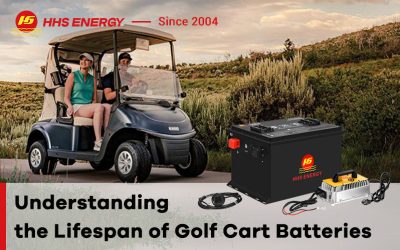
HHS Energy provides OEM/ODM lithium battery solutions for B2B applications. For golf cart and outdoor vehicle projects, the battery configuration should be selected according to the vehicle’s motor, controller, installation space, expected workload, and environmental requirements.
Explore HHS Golf Energy Golf Cart Batteries for more information.
How to Choose the Right Electric Hunting Golf Cart
Before purchasing an electric hunting golf cart or selecting a platform for distribution, evaluate the following checklist.
The most suitable vehicle is not necessarily the one with the largest motor, biggest tires, or highest advertised battery capacity. It is the vehicle whose complete design matches the intended terrain, payload, range, and safety requirements.
Frequently Asked Questions
Conclusion
Electric golf carts offer a practical transportation option for hunting properties, farms, resorts, campgrounds, and other outdoor environments when the vehicle is properly matched to the terrain and workload.
The most important buying considerations include off-road tires, ground clearance, suspension, drivetrain, payload, battery capacity, discharge current, and charging compatibility. Battery technology also plays a significant role: lead-acid remains a cost-conscious option, while LiFePO₄ can offer lower weight, reduced maintenance, and flexible configurations for demanding use.
For hunters, the goal is to select a vehicle that safely transports people and equipment across the intended property. For manufacturers, distributors, and private-label brands, the opportunity lies in matching the complete vehicle and battery system to a clearly defined application.
With the right specifications and realistic expectations, an electric golf cart can serve as a versatile outdoor utility vehicle—not just a way to travel between golf holes.
Need a battery solution for your off-road hunting cart?
HHS Energy provides custom LiFePO₄ battery packs designed for demanding outdoor applications. We help you match voltage, capacity, BMS, and charger to your specific hunting cart platform.
HHS Energy — Lithium Battery Solutions for Golf Carts & Electric Vehicles
© 2025 HHS Energy | Smart Battery Technology