Best Practices for Effective Golf Cart Battery Maintenance
Golf cart battery maintenance is essential for preserving battery performance, reducing unexpected downtime, and extending the useful service life of the vehicle. However, the correct maintenance procedure depends heavily on the battery chemistry.
Flooded lead-acid batteries require regular electrolyte checks, distilled-water maintenance, terminal inspection, and cleaning. Lithium iron phosphate (LiFePO₄) golf cart batteries eliminate watering but still require proper charging, temperature control, connection inspection, storage management, and BMS protection.
For golf cart dealers, fleet operators, distributors, and OEMs, battery maintenance should be viewed as part of the entire power system rather than simply a routine battery-cleaning task.
This guide explains how to maintain both lead-acid and lithium golf cart batteries, what should be checked daily, weekly, and monthly, which maintenance practices actually affect battery life, and how B2B operators can build a practical battery maintenance program.
Quick Answer: How Should You Maintain a Golf Cart Battery?
The most important rule is simple: Maintain the battery according to its chemistry and manufacturer specifications. Do not apply lead-acid maintenance procedures to lithium batteries, or lithium charging practices to lead-acid batteries.
Golf Cart Battery Maintenance Checklist: Lithium vs. Lead-Acid
a quick-reference matrix for daily, weekly, monthly, and periodic checks across both battery chemistries.
Why Golf Cart Battery Maintenance Matters
Golf cart batteries operate under repeated charge and discharge cycles. Every acceleration, hill climb, passenger load, and extended driving session places an electrical and thermal load on the battery system.
Poor maintenance can contribute to:
- Reduced driving range
- Voltage sag
- Longer charging times
- Corroded terminals
- Increased electrical resistance
- Battery imbalance
- Charging faults
- Premature capacity loss
- Unexpected shutdowns
- Vehicle downtime
For commercial fleets, these problems can have a larger impact because one poorly maintained battery can become an operational issue rather than simply an inconvenience.
A good maintenance program therefore has two objectives:
- Protect the battery – Prevent avoidable degradation caused by incorrect charging, overheating, corrosion, low electrolyte levels, or prolonged storage in an unsuitable condition.
- Detect problems early – Identify abnormal voltage, temperature, connections, capacity, or charging behavior before the problem becomes a vehicle failure.
Start With the Battery Chemistry
The first step in golf cart battery maintenance is identifying what type of battery is installed. Common golf cart battery technologies include: flooded lead-acid, AGM lead-acid, gel lead-acid, and LiFePO₄ lithium-ion.
These batteries do not require the same maintenance procedures. For example, Club Car’s maintenance guidance for electric vehicles recommends checking water levels monthly on applicable batteries and adding distilled water only after fully charging. It also recommends keeping battery tops and terminals clean.
By contrast, lithium batteries do not have removable electrolyte that requires routine watering. That difference should be reflected in the maintenance checklist used by dealers and fleet operators.
Golf Cart Battery Maintenance Schedule
For high-utilization commercial fleets, the inspection frequency should be increased according to operating hours and manufacturer recommendations. Yamaha’s golf-car maintenance documentation similarly separates maintenance into daily and monthly activities, including battery charging, cleaning, terminal/hold-down checks, electrolyte inspection, and electrical connections.
1. Perform a Visual Battery Inspection
A visual inspection is one of the simplest ways to identify developing battery problems. Look for: cracks, swelling, leakage, corrosion, damaged cables, loose terminals, damaged connectors, burn marks, abnormal odors, water accumulation, damaged battery enclosure, and loose mounting hardware.
For lithium batteries, do not open the battery enclosure to perform internal repairs unless you are an appropriately qualified service provider following the manufacturer’s procedures. A lithium battery’s external condition can often provide important information without opening the pack.
2. Keep Battery Terminals and Connections Clean
Electrical connections are often overlooked during routine maintenance. A contaminated or loose terminal can increase electrical resistance, resulting in voltage drop, heat generation, reduced efficiency, intermittent faults, poor acceleration, and charging problems.
Club Car specifically recommends checking terminal tightness, while Yamaha includes electrical-connection inspection as part of its maintenance program.
HHS Golf Energy Maintenance Principle: For every battery installation, the maintenance checklist should include: Battery terminal → Cable lug → Fastener → Cable insulation → Connector → Controller connection. Do not inspect the battery in isolation.
3. Follow the Correct Torque Specification
A battery terminal should not simply be tightened “as hard as possible.” Over-tightening can damage terminals, inserts, busbars, threaded components, and battery housing. Under-tightening can create electrical resistance and heat.
For example, Club Car’s current guidance lists 110 in-lb for certain Onward battery terminal nuts, while also emphasizing that owners should refer to the specific owner’s manual.
This illustrates an important B2B maintenance principle: Never use a universal torque value for every golf cart battery. Follow the battery and vehicle manufacturer’s specified torque. For commercial fleets, a calibrated torque wrench should be included in the maintenance process.
4. Flooded Lead-Acid Battery Watering
Flooded lead-acid batteries require one maintenance task that lithium batteries do not: electrolyte/water level management. Trojan states that flooded batteries require regular watering because water is lost during charging. Its guidance recommends checking levels regularly and using distilled water.
Correct procedure:
- Inspect the electrolyte level.
- Make sure the battery is charged according to the manufacturer’s instructions.
- Add distilled water as specified.
- Never add acid as part of routine watering.
- Avoid overfilling.
- Keep the battery exterior clean and dry.
Trojan’s current watering guidance specifies that after charging, the electrolyte should be approximately 1/8 inch below the bottom of the vent well for its applicable flooded batteries. That is a manufacturer-specific specification, however, so it should not automatically be applied to every flooded battery.
5. Never Ignore Low Electrolyte Levels
The purpose of electrolyte maintenance is not simply to keep the battery “full of water.” The electrolyte needs to remain at the correct level so the internal plates remain properly covered. Trojan notes that allowing electrolyte levels to fall below the tops of the plates can cause irreversible damage. This is why fleet operators should not wait until a battery visibly looks dry before checking it.
6. Do Not Over-Water Lead-Acid Batteries
More water is not better. Overfilling can cause electrolyte overflow during charging. Trojan specifically warns that excessive watering can dilute the electrolyte and reduce battery performance, while watering before charging can contribute to overflow. A good maintenance rule is: Maintain the correct electrolyte level—not the maximum possible level.
7. Use Distilled Water & 8. Lithium Batteries Do Not Need Watering
For flooded lead-acid golf cart batteries, distilled water is generally preferred because it minimizes the introduction of minerals and contaminants. Trojan recommends distilled water for its flooded batteries. For fleet operations, keeping a dedicated supply of appropriate distilled water can make maintenance more consistent.
One of the major maintenance differences between lithium and flooded lead-acid batteries is the elimination of electrolyte watering. A properly enclosed LiFePO₄ golf cart battery does not require routine water filling, acid checking, electrolyte topping, or equalization watering.
However, maintenance-free does not mean maintenance-free forever. Lithium batteries still require correct charging, temperature management, connection inspection, physical inspection, storage management, BMS monitoring, and charger compatibility. Allied’s current lithium maintenance guidance similarly emphasizes correct charging, avoiding excessive discharge, checking terminals, inspecting chargers, and proper storage.
9. Use the Correct Golf Cart Battery Charger
Charger compatibility is one of the most important maintenance issues. A charger must match battery chemistry, system voltage, charging voltage, charging current, communication requirements, and BMS requirements. Do not assume that a charger designed for a lead-acid battery is automatically suitable for a lithium battery. The same principle applies in reverse. A battery manufacturer should specify the appropriate charger or charger profile.
10. Charge Lithium Batteries According to the Manufacturer
There is no single universal SOC rule that applies to every lithium golf cart battery. For example, some manufacturers recommend charging lithium batteries after each use, while others provide specific storage and operating SOC windows. Allied’s current golf cart battery guidance recommends charging lithium batteries after use and avoiding routine operation below approximately 20% SOC.
For HHS Golf Energy products, the maintenance instructions should be based on the actual cell chemistry, BMS programming, charger, and intended application. That is more technically accurate than publishing one generic SOC number for every LiFePO₄ battery.
11. Avoid Repeated Deep Discharge
Repeatedly operating a battery at extremely low SOC can increase stress on the battery system. For lithium batteries, the BMS provides protection against excessive discharge, but BMS protection should not be treated as the normal operating strategy. A useful fleet rule is: Recharge before the battery reaches the manufacturer’s low-SOC limit. This provides operational margin and reduces the likelihood of a vehicle becoming stranded with insufficient energy.
12. Understand the Role of the BMS
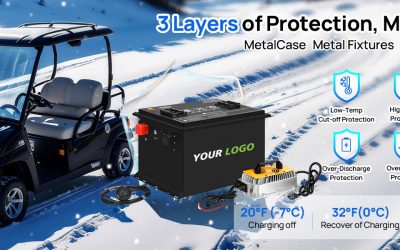
The Battery Management System is one of the most important components inside a modern lithium golf cart battery. A BMS can monitor and protect against conditions such as cell overvoltage, cell undervoltage, overcurrent, short circuit, overtemperature, low-temperature charging, and cell imbalance. The exact protection functions depend on the BMS design.
For a B2B buyer, asking only for “51.2V 100Ah” is not enough. You should also request: continuous discharge current, peak discharge current, charge current, BMS model/specification, temperature protection range, communication protocol, SOC accuracy, CAN communication if required, and Bluetooth functionality if required.
How a LiFePO₄ Golf Cart Battery BMS Protects the Battery
Cell → Cell Monitoring → BMS → MOS/Relay → Controller, with protection coverage for overcharge, over-discharge, overcurrent, short circuit, high/low temperature, and cell imbalance.
13. Keep the Battery and Compartment Clean
Dirt, moisture, dust, corrosion, and debris can accumulate around a golf cart battery compartment. For lead-acid batteries, acid residue can accelerate corrosion. For lithium batteries, contamination around connectors and electrical components can also create maintenance problems.
Keep battery surfaces, cable terminals, connectors, battery tray, charger connectors, and nearby electrical components clean and dry. For flooded lead-acid systems, Club Car recommends cleaning battery tops and terminals monthly and specifically warns against allowing the cleaning solution into the battery.
14. Avoid High-Pressure Washing
A golf cart may be washed, but battery compartments require more care. High-pressure water can enter connectors, electrical components, battery vents, wiring harnesses, and controller areas. The correct cleaning method depends on the vehicle and battery manufacturer’s instructions. For example, Club Car recommends gentle rinsing rather than pressure washing around applicable battery areas.
15. Monitor Battery Temperature
Temperature has a direct effect on battery performance and aging. Trojan notes that higher temperatures can increase battery capacity in the short term but generally at the expense of battery life, while colder temperatures reduce available capacity.
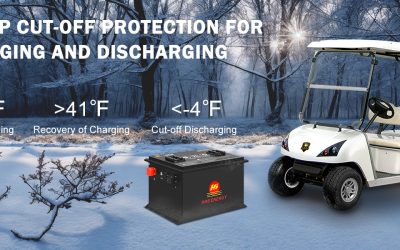
This creates an important distinction: Temperature can affect both performance and longevity, but not always in the same direction. For lithium batteries, temperature monitoring is particularly important because charging at unsuitable temperatures can create safety and reliability concerns. The exact allowable charging temperature should always come from the battery manufacturer.
16. Do Not Store Golf Cart Batteries in Extreme Conditions
Long-term storage should be planned rather than simply parking the golf cart and leaving it untouched. Before storage: clean the battery and compartment, check battery condition, charge or discharge to the manufacturer’s recommended storage SOC, disconnect unnecessary loads, store in an appropriate environment, inspect periodically, and follow the manufacturer’s recharge interval.
Lithium storage requirements can differ substantially from lead-acid requirements, so the battery manual should be treated as the primary reference.
17. Storage Maintenance for Commercial Fleets
For a fleet with dozens or hundreds of golf carts, “check the batteries occasionally” is not a sufficient maintenance strategy. Instead, create a battery log.
Lead-Acid vs. LiFePO₄ Maintenance Workflow Comparison
a side-by-side view of routine maintenance tasks for flooded lead-acid and HHS LiFePO₄ golf cart batteries.
18. Create a Battery Inspection Checklist
Before Operation: Check battery SOC, warning indicators, battery enclosure, visible cables, connectors, corrosion, and confirm no abnormal odor or heat.
Weekly: Inspect terminals, cable insulation, mounting hardware, charger connector, review abnormal charging events, and check battery compartment cleanliness.
Monthly (Lead-Acid): Check electrolyte level, add distilled water if required, inspect corrosion, clean terminals, and check connections.
Monthly (Lithium): Review BMS status, check SOC accuracy, inspect charger, check terminals, check enclosure, and review temperature/fault records.
Periodically: Verify terminal torque, check battery capacity/performance, inspect charger output, review maintenance history, check vehicle electrical system, and evaluate battery replacement condition.
19. Lead-Acid vs. Lithium Maintenance: What Really Changes?
20. What Battery Maintenance Actually Proves?
For a battery manufacturer or B2B supplier, saying “our batteries require little maintenance” is not enough. The better approach is to demonstrate what the product design eliminates and what still needs to be maintained.
Flooded Lead-Acid: Watering → electrolyte inspection → corrosion cleaning → terminal inspection → charging → storage.
HHS Lithium: BMS protection → charging → temperature monitoring → terminal inspection → storage → performance monitoring.
21. Battery Maintenance Should Start With Battery Design
Maintenance is not only an after-sales issue. It begins during battery engineering. A well-designed golf cart battery should consider:
- Cell selection: capacity, internal resistance, cycle requirements, discharge rate, temperature performance, consistency.
- BMS design: matched to motor/controller requirements, continuous current, peak current, charging current, temperature conditions, communication requirements.
- Mechanical design: enclosure should account for vibration, impact, mounting, connector placement, cable routing, heat dissipation, environmental exposure.
- Production quality: cell matching, welding quality, insulation, busbar connection, torque control, end-of-line testing, functional BMS testing, pack-level inspection.
This is why the battery manufacturer matters as much as the battery specification.
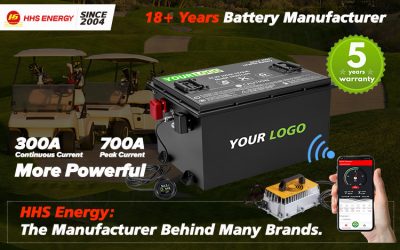
22. How HHS Energy Approaches Golf Cart Battery Reliability
For OEM/ODM golf cart battery projects, HHS Energy can develop battery systems around the customer’s vehicle and application requirements rather than treating voltage and Ah as the only design parameters. A golf cart battery project can be evaluated around: 36V / 38.4V systems, 48V / 51.2V systems, 72V / 73.6V systems, LiFePO₄ cell configuration, capacity, continuous discharge current, peak discharge current, BMS configuration, CAN communication, Bluetooth, GPS, battery heater, charger compatibility, enclosure dimensions, mounting system, connectors, cable configuration, and certification requirements.
For B2B customers, this allows the maintenance requirements to be considered during product development rather than after the battery has already entered the market.
HHS Factory: Terminal, Welding & Testing
HHS Energy performs pack-level inspection and testing before shipment, helping ensure consistent electrical and mechanical performance across production batches.
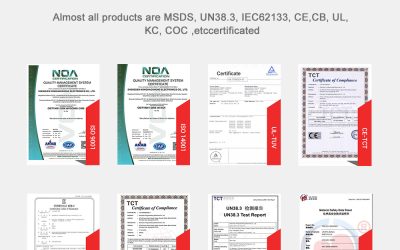
23. Battery Certifications and Maintenance Reliability
Certification does not replace maintenance, but it can be an important part of battery qualification. IEC 62619:2022 specifies safety requirements and tests for secondary lithium cells and batteries used in industrial applications, and its scope explicitly includes golf carts among motive applications. UL also maintains application-specific battery safety standards and testing programs.
For B2B buyers, certification documentation should therefore be reviewed together with: battery model, cell configuration, BMS, rated voltage, capacity, production configuration, and intended application. A certification document for one battery configuration should not automatically be assumed to cover every battery model from the same supplier.
24. How to Know When a Golf Cart Battery Needs Replacement
Maintenance cannot restore a battery that has reached the end of its useful service life. Look for a combination of symptoms:
- Performance symptoms: noticeably reduced range, significant voltage drop under load, slower acceleration, poor hill-climbing, unexpected shutdown, longer charging times.
- Physical symptoms: cracks, leakage, severe corrosion, swelling, damaged enclosure, burn marks, abnormal heat.
- Electrical symptoms: charger repeatedly stops, BMS protection activates unexpectedly, large voltage imbalance, abnormal resting voltage, repeated low-voltage faults.
One symptom alone does not necessarily prove battery failure. A proper diagnosis should consider the battery, charger, controller, wiring, motor, and vehicle load.
25. Don’t Blame the Battery Too Quickly
A golf cart that suddenly has less range does not necessarily have a defective battery. Other causes can include: underinflated tires, brake drag, excessive vehicle load, controller problems, motor problems, charger problems, loose connections, incorrect battery settings, accessory loads, and extreme temperatures. For fleet maintenance, troubleshooting should therefore follow a structured process.
Golf Cart Battery Troubleshooting Flowchart
HHS diagnostic flow — Reduced Range → Check Tire/Mechanical Resistance → Check Battery SOC & Voltage → Check Charger → Check Terminals & Cables → Check BMS Fault History → Capacity Test → Battery/Charger/Vehicle Diagnosis.
26. The Difference Between Battery Maintenance and Battery Management
Battery maintenance involves physical and operational tasks such as cleaning, terminal inspection, watering, charger inspection, storage, and mounting inspection. Battery management involves system-level monitoring such as SOC, voltage, current, temperature, cell balance, BMS protection, fault records, and charging history.
Modern lithium golf cart batteries combine both concepts. The physical battery requires relatively little routine maintenance, while the BMS provides continuous electronic monitoring and protection.
27. Best Practices for Golf Cart Dealers
For golf cart dealers, battery maintenance should become part of the customer handover process. A dealer should provide: installation documentation, battery model, voltage, capacity, charger model, wiring diagram, BMS information, maintenance documentation, charging instructions, storage instructions, temperature limits, inspection intervals, terminal torque, warranty requirements, troubleshooting documentation, BMS fault codes, charger fault codes, low-voltage procedures, contact information, and warranty process. This reduces unnecessary service calls and improves consistency across installations.
28. Best Practices for Golf Cart Fleet Operators
Fleet operators have a different objective from individual golf cart owners. The focus should be: maximum uptime + predictable maintenance + measurable battery health.
This converts battery maintenance from a reactive task into a data-driven fleet management process.
29. HHS Recommended Golf Cart Battery Maintenance Matrix
*Frequency should be adjusted according to battery manufacturer instructions, operating conditions, climate, and usage. This table is an HHS-recommended maintenance framework, not a substitute for the battery or vehicle manufacturer’s service manual.
30. Frequently Asked Questions
Conclusion: Effective Golf Cart Battery Maintenance Starts With the Right Battery
Effective golf cart battery maintenance is not simply about cleaning terminals or plugging in the charger. The correct maintenance strategy depends on the battery chemistry, vehicle architecture, operating environment, and usage pattern.
For flooded lead-acid batteries, the major maintenance priorities are: electrolyte level, distilled-water management, terminal cleaning, corrosion prevention, correct charging, and connection inspection.
For LiFePO₄ lithium golf cart batteries, the emphasis shifts toward: correct charger compatibility, SOC management, BMS monitoring, temperature control, terminal and cable inspection, storage management, and system-level troubleshooting.
The best maintenance program is also preventive rather than reactive. Dealers and fleet operators should maintain inspection records, track battery performance, and investigate changes in voltage, range, charging behavior, or temperature before they become vehicle downtime.
For golf cart OEMs, distributors, and battery brands, the process begins even earlier: battery maintenance should be considered during cell selection, BMS design, mechanical engineering, charger matching, testing, and production quality control. That is the foundation for a reliable golf cart battery system.
HHS Energy Test Data Disclaimer
Test results shown on this page are based on specified battery configurations and laboratory or production inspection conditions. Actual performance may vary depending on battery configuration, vehicle model, controller, charger, ambient temperature, load, and operating conditions.
HHS 51.2V Golf Cart Battery Real Test Data
Actual HHS test data — Nominal Voltage, Rated Capacity, Continuous Discharge, Peak Discharge, Charge Current, Operating Temperature, Low-Temperature Charge Protection, BMS Communication, Test Date, Sample ID. (Use only verified HHS data.)
Need a maintenance-friendly golf cart battery?
HHS Energy provides custom lithium battery packs designed for low maintenance, long cycle life, and reliable performance. We help you choose the right chemistry, BMS, and charger for your fleet or OEM project.
HHS Energy — Lithium Battery Solutions for Golf Carts & Electric Vehicles
© 2025 HHS Energy | Smart Battery Technology