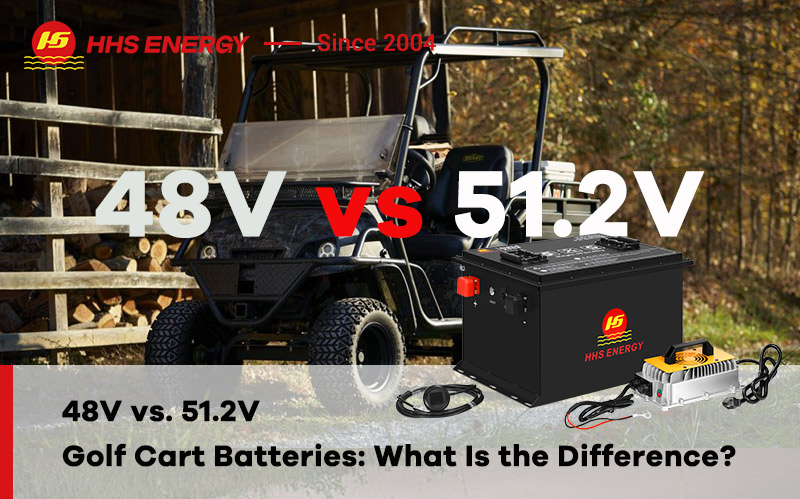
48V vs. 51.2V Golf Cart Batteries: What Is the Difference?
For golf cart manufacturers, dealers, distributors, and fleet operators, choosing between a 48V and 51.2V golf cart battery can be confusing. Both are commonly associated with “48V-class” golf carts, and both may be advertised as replacements for traditional 48V battery systems. However, they are not electrically identical.
The key difference is the battery chemistry and cell configuration. A conventional 48V lithium battery may use a nominal 48V architecture, while a 51.2V LiFePO₄ battery typically consists of 16 lithium iron phosphate cells connected in series, with each cell having a nominal voltage of about 3.2V:
3.2V × 16 = 51.2V nominal
Despite the higher nominal voltage, a 51.2V LiFePO₄ battery is generally designed for applications commonly described as 48V golf cart systems. In many cases, it can provide higher usable energy, more stable voltage under load, longer cycle life, and a simpler replacement solution than lead-acid batteries.
For B2B buyers, however, the most important question is not simply whether 51.2V is better than 48V. The real question is whether the battery’s voltage range, BMS, charger, controller, motor, communications protocol, dimensions, connectors, and safety requirements are compatible with the target golf cart.
This guide explains the differences in detail and provides a practical framework for selecting the right battery architecture.
48V vs. 51.2V Golf Cart Batteries at a Glance
The most important point is that 48V and 51.2V are not necessarily competing voltage classes in golf cart applications. A 51.2V LiFePO₄ battery is commonly used as a lithium replacement for systems historically described as 48V.
What Does 48V Mean in a Golf Cart?
The term 48V golf cart battery traditionally refers to a battery system designed around a 48V nominal electrical architecture. Historically, many golf carts used lead-acid batteries arranged in series. For example, a 48V system might use:
- Six 8V lead-acid batteries
- Four 12V lead-acid batteries
- Another series configuration that produces approximately 48V nominal
The actual voltage of a lead-acid battery is not fixed at 48V. A “48V” lead-acid golf cart battery system can have a significantly higher voltage immediately after charging and a much lower voltage as the battery discharges.
This is important because nominal voltage is a classification, not the actual voltage at every operating point. The same principle applies to lithium batteries.
What Is a 51.2V Golf Cart Battery?
A 51.2V golf cart battery is typically a 16-series-cell LiFePO₄ battery. Each LiFePO₄ cell has a nominal voltage of approximately 3.2V:
16 × 3.2V = 51.2V
This is why many modern lithium golf cart batteries are labeled: 48V, 51.2V, 48V/51.2V, or 51.2V LiFePO₄. These terms can describe batteries intended for the same general golf cart voltage class, but the exact electrical specifications must still be checked.
A typical 51.2V LiFePO₄ battery has a charging voltage of approximately 58.4V when using a 3.65V-per-cell maximum charging voltage:
16 × 3.65V = 58.4V
The battery then operates over a voltage range as its state of charge changes. This is one reason why comparing only the “48V” and “51.2V” labels can be misleading.
Why Is a 51.2V Battery Called a 48V Golf Cart Battery?
This is one of the most common questions from golf cart battery buyers. The answer is that 48V has become a widely used system designation, while 51.2V describes the nominal voltage resulting from a particular lithium cell configuration.
Think of it this way: 48V describes the application/system class, while 51.2V describes the nominal voltage of a common 16S LiFePO₄ battery architecture.
For example, a golf cart originally designed around a 48V lead-acid battery system may be converted to a 51.2V LiFePO₄ battery. That does not automatically mean the vehicle has become a completely different voltage system.
What matters is whether the battery’s:
- Operating voltage range
- Maximum charging voltage
- BMS limits
- Continuous current
- Peak current
- Controller
- Charger
- Motor
- DC-DC converter
- Communication interface
are compatible. Therefore, B2B buyers should evaluate electrical compatibility rather than relying only on the label printed on the battery.
48V vs. 51.2V: The Cell Configuration Difference
The biggest technical difference is often the number of cells connected in series.
A 15S LiFePO₄ battery is nominally 48V. A 16S LiFePO₄ battery is nominally 51.2V. However, 16S LiFePO₄ has become a very common architecture for batteries marketed for 48V-class applications, including golf carts. This is partly because the voltage profile of LiFePO₄ makes 16S configurations a practical replacement architecture for many existing 48V systems.
Does 51.2V Provide More Power Than 48V?
Potentially, yes—but voltage alone does not determine the actual power output. Electrical power can be approximated as:
Power (W) = Voltage (V) × Current (A)
For example:
- A 48V battery delivering 200A: 48 × 200 = 9,600W
- A 51.2V battery delivering 200A: 51.2 × 200 = 10,240W
At the same current, the 51.2V battery can theoretically deliver approximately 6.7% more electrical power. However, this does not mean installing a 51.2V battery automatically makes every golf cart 6.7% faster. The vehicle’s actual performance also depends on motor design, controller limits, BMS current limits, battery internal resistance, state of charge, vehicle weight, tire size, terrain, gear ratio, and temperature.
51.2V LiFePO₄ Can Maintain Voltage Better Under Load
One major advantage of LiFePO₄ technology is its relatively stable voltage during much of the discharge cycle. This can be important in golf carts because the battery experiences large changes in current. For example, current demand may increase significantly during hill climbing, acceleration, carrying passengers, carrying cargo, driving on rough terrain, towing, or starting from a standstill.
Lead-acid batteries can experience significant voltage sag under heavy loads. A properly designed lithium battery can maintain a more stable voltage, helping the vehicle’s electrical system operate more consistently. However, the result depends heavily on battery design. A battery with undersized cells, inadequate busbars, excessive resistance, or an undersized BMS may not deliver the expected performance simply because it uses LiFePO₄ chemistry.
Energy Capacity Matters More Than Voltage Alone
When comparing golf cart batteries, buyers should also consider watt-hours (Wh). The basic formula is:
Energy (Wh) = Voltage (V) × Capacity (Ah)
For example:
- 48V 100Ah battery: 48 × 100 = 4,800Wh
- 51.2V 100Ah battery: 51.2 × 100 = 5,120Wh
Therefore, at the same nominal Ah rating, a 51.2V battery contains approximately 6.7% more nominal energy. This is one reason a 51.2V 100Ah LiFePO₄ battery can be an attractive option for 48V-class golf carts. But nominal energy is not the whole story. Usable energy also depends on recommended depth of discharge, BMS cutoff settings, cell characteristics, temperature, discharge current, battery aging, and system efficiency. A battery’s usable watt-hours are often more meaningful than its nominal Ah rating when comparing products.
Does a 51.2V Battery Increase Golf Cart Speed?
It can, but it should not be assumed. A higher battery voltage can increase the available electrical power if the motor controller is capable of using it. But modern golf cart systems often have carefully programmed controller limits. If the controller is designed to operate within a particular voltage range, installing a different battery without validating compatibility can cause controller faults, overvoltage protection, communication errors, reduced performance, unexpected shutdown, or component damage in poorly matched systems.
For this reason, voltage compatibility should be verified before attempting to increase system voltage. A 51.2V battery intended as a direct replacement for a 48V system is different from deliberately upgrading a vehicle to a substantially higher voltage architecture.
51.2V LiFePO₄ vs. 48V Lead-Acid Golf Cart Batteries
For many golf cart applications, the more meaningful comparison is not “48V lithium vs. 51.2V lithium.” It is: 48V lead-acid vs. 51.2V LiFePO₄. The difference can be significant.
The exact difference depends on the battery models being compared, but lithium technology generally offers significant advantages for commercial fleets and high-use golf carts.
Weight: One of the Biggest Advantages of Lithium
Golf cart batteries can account for a substantial portion of the vehicle’s total weight. Traditional lead-acid battery systems are heavy. Replacing them with a properly designed lithium battery can significantly reduce battery weight. Lower battery weight can affect acceleration, hill climbing, energy consumption, handling, tire loading, suspension load, and transport costs. For fleet operators, reducing weight can also simplify maintenance and battery replacement.
However, the battery should never be selected based on weight alone. Structural mounting, vibration resistance, enclosure design, and electrical safety remain essential.
Charging Requirements & BMS Role
The charger is one of the most important components when replacing a golf cart battery. A charger designed for lead-acid chemistry should not automatically be assumed to be compatible with a 51.2V LiFePO₄ battery. LiFePO₄ batteries require an appropriate charging profile.
A typical 16S LiFePO₄ battery reaches approximately 58.4V maximum charging voltage when using a 3.65V/cell maximum. But the exact charging requirements depend on cell manufacturer, battery configuration, BMS settings, recommended charge voltage, charge current, temperature limits, charger communication, and manufacturer specifications.
For B2B projects, the charger should therefore be treated as part of the battery system rather than as an independent accessory.
Why Charger Communication Matters
Modern golf carts may use intelligent charger communication. A lithium conversion may require the battery and charger to communicate correctly. Depending on the vehicle architecture, communication may involve CAN bus, enable signals, charge-enable logic, state-of-charge information, current limits, or fault signals. An otherwise correctly sized battery may not work properly if the charger communication protocol is incompatible. For OEM and ODM projects, suppliers should verify the complete communication architecture before mass production.
The Role of the BMS in a 51.2V Golf Cart Battery
A lithium golf cart battery needs a Battery Management System (BMS). The BMS helps monitor and protect cell voltage, pack voltage, charging current, discharging current, temperature, overvoltage, undervoltage, overcurrent, short circuit, high temperature, and low-temperature charging.
For a golf cart, the BMS must also be matched to the expected load. A small recreational golf cart may have very different current requirements from a commercial utility vehicle operating on steep terrain. Therefore, BMS selection should consider:
- Continuous current: How much current the battery can safely deliver continuously.
- Peak current: How much current can be delivered for short periods during acceleration or heavy loads.
- Protection response: How the BMS responds to abnormal operating conditions.
- Communication: Whether the BMS supports Bluetooth, CAN bus, or another communication protocol required by the vehicle.
Why Peak Current Matters for Golf Carts
Golf carts do not consume a constant amount of current. During cruising on level ground, current demand may be moderate. During acceleration or hill climbing, demand can rise substantially. Therefore, a battery specification such as 51.2V 100Ah does not tell you enough about the battery’s performance. Two 51.2V 100Ah batteries can have very different performance characteristics. One may support 100A continuous discharge. Another may support 200A or more. For high-performance applications, peak current capability becomes particularly important.
Range & Battery Lifespan
Range depends on several factors, but battery energy is a major factor. A simplified calculation is:
Range ≈ Usable Battery Energy ÷ Average Energy Consumption
For example, if a battery provides approximately 5.12kWh of nominal energy, the actual driving range will depend on how efficiently the golf cart converts that energy into movement. Factors include vehicle weight, passenger/cargo load, tire pressure, terrain, driving speed, acceleration behavior, motor efficiency, controller efficiency, wind, temperature, and battery age.
Therefore, it is not accurate to claim that every 51.2V battery will provide a specific number of miles. For fleet customers, real-world testing on the intended vehicle platform is much more useful.
What About Battery Lifespan?
LiFePO₄ batteries are generally known for long cycle life compared with traditional lead-acid batteries. However, actual service life depends on depth of discharge, charge/discharge current, operating temperature, storage conditions, cell quality, BMS protection, mechanical design, and charging practices. For example, repeatedly operating a battery at very high temperatures and deep discharge levels can accelerate degradation.
A high-quality battery design should therefore combine good cells with correct BMS parameters, effective thermal management, proper busbar design, reliable welding, accurate cell matching, and robust enclosure construction.
Which Is Better: 48V or 51.2V?
There is no universal answer.
Choose a 48V architecture when:
- The vehicle is specifically designed around a 48V battery architecture.
- The controller requires a particular voltage range.
- The battery supplier offers a verified 48V configuration.
- The application requires a specific 15S lithium design.
- Existing system electronics have strict voltage requirements.
Consider a 51.2V LiFePO₄ battery when:
- The vehicle is a compatible 48V-class golf cart.
- You want a common 16S LiFePO₄ architecture.
- Higher usable energy per Ah is beneficial.
- Long cycle life is important.
- Low maintenance is a priority.
- Reduced battery weight is desirable.
- The charger and controller are compatible.
The correct choice should always be based on the complete electrical system, not just the number printed on the battery label.
Can You Replace a 48V Lead-Acid Battery With a 51.2V Lithium Battery?
In many golf cart applications, yes, but compatibility must be verified. A typical conversion requires checking:
- Battery voltage range
- Controller operating voltage
- Motor specifications
- Charger voltage and charging profile
- Charger communication
- BMS current rating
- DC-DC converter input range
- Battery dimensions
- Terminal configuration
- Mounting structure
- Vehicle wiring
- Safety requirements
The battery should not be installed simply because both products are marketed as “48V.”
What B2B Buyers Should Check Before Ordering
For dealers, distributors, importers, and golf cart manufacturers, battery selection should begin with a technical specification sheet. At minimum, request:
- Electrical specifications: nominal voltage, operating voltage range, rated capacity, usable capacity, maximum charge voltage, standard charge current, maximum continuous discharge current, peak discharge current.
- Mechanical specifications: dimensions, weight, mounting holes, terminal position, connector type, enclosure material, IP rating.
- BMS specifications: overcharge protection, over-discharge protection, overcurrent protection, short-circuit protection, temperature protection, communication protocol, Bluetooth/GPS availability if required.
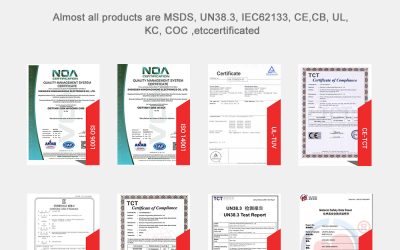
- Compliance documentation: depending on the target market and application, buyers may need UN 38.3, MSDS/SDS, CE, EMC-related documentation, RoHS, relevant battery safety testing, and quality management documentation.
The exact requirements depend on the market, product configuration, transportation method, and intended application.
OEM Design & HHS Energy Solutions
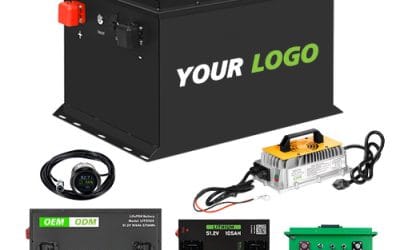
A standard battery may work for one golf cart but fail to meet the requirements of another. OEM/ODM projects can customize voltage, capacity, cell configuration, BMS current, communication protocol, enclosure, mounting, connectors, cable length, display, Bluetooth, GPS, heating, charger, branding, and firmware.
For example, a fleet application may require higher peak discharge capability than a standard recreational vehicle. A golf cart manufacturer may also need a battery enclosure that fits a specific battery compartment without modifying the chassis. This is where an experienced battery manufacturer can provide substantially more value than simply supplying cells.
HHS Energy: For golf cart manufacturers, dealers, distributors, and battery brands looking for an OEM/ODM partner, HHS Energy can develop customized lithium battery solutions around the actual vehicle requirements. A custom project can be evaluated based on 48V/51.2V system requirements, LiFePO₄ cell configuration, capacity, continuous and peak current, BMS protection strategy, charger compatibility, CAN bus communication, Bluetooth, GPS, heating functions, enclosure dimensions, connector requirements, mounting configuration, and certification requirements.
For a commercial golf cart battery, the objective is not simply to build a battery with the desired voltage. The battery needs to function reliably as part of the vehicle’s complete power system.
Common Mistakes When Comparing 48V and 51.2V Batteries
- Mistake 1: Assuming 51.2V Is Always Too High – A 51.2V LiFePO₄ battery is commonly used in 48V-class golf cart applications. The label alone does not determine compatibility.
- Mistake 2: Comparing Only Ah – A 48V 100Ah battery and a 51.2V 100Ah battery do not contain exactly the same nominal energy. Always calculate: Wh = V × Ah.
- Mistake 3: Ignoring the BMS – A battery may have excellent cells but still perform poorly if the BMS is undersized or incorrectly configured.
- Mistake 4: Reusing the Original Lead-Acid Charger – Lithium batteries require an appropriate charging profile. Charger compatibility must be verified.
- Mistake 5: Looking Only at Peak Current – Peak current is important, but continuous current, thermal performance, cell capability, and BMS behavior are also critical.
- Mistake 6: Assuming Every 51.2V Battery Is Identical – Two batteries can both be labeled 51.2V 100Ah while using different cells, BMS, busbars, wiring, enclosures, firmware, and thermal designs. Specification comparison should therefore go much deeper than nominal voltage and capacity.
Frequently Asked Questions
Final Takeaway: 48V vs. 51.2V Golf Cart Batteries
The difference between 48V and 51.2V golf cart batteries is primarily related to battery architecture and chemistry, rather than simply two completely different golf cart voltage classes.
A conventional 48V system has historically been associated with lead-acid battery configurations. Meanwhile, 51.2V LiFePO₄ has become a common lithium architecture for 48V-class golf carts, using 16 series-connected LiFePO₄ cells. A 51.2V 100Ah battery also has approximately 5.12kWh of nominal energy, compared with 4.8kWh for a 48V 100Ah battery.
But the voltage number should never be the only selection criterion. For B2B golf cart battery projects, the better approach is to evaluate the entire system:
Battery → BMS → Charger → Controller → Motor → Communication → Vehicle
When these components are properly matched, a 51.2V LiFePO₄ battery can provide a compelling combination of high usable energy, stable voltage, low maintenance, reduced weight, and long service life.
For OEMs, distributors, and golf cart battery suppliers, the most reliable solution is to define the vehicle’s electrical and mechanical requirements first and then select the appropriate battery architecture.
Need help choosing between 48V and 51.2V?
HHS Energy provides custom lithium battery packs for 48V-class and 51.2V golf cart systems. We help you match voltage, capacity, BMS, charger, and communication to your specific vehicle requirements.
HHS Energy — Lithium Battery Solutions for Golf Carts & Electric Vehicles
© 2025 HHS Energy | Smart Battery Technology