Lithium Golf Cart Battery Manufacturer, Suppliers, Factory > News > Golf Cart Lithium Battery Blog > Buying Guides & Recommendations > Understanding the Key Certifications for Golf Cart Batteries
Understanding the Key Certifications for Golf Cart Batteries
Understanding the Key Certifications for Golf Cart Batteries
When purchasing a golf cart battery for personal use, fleet operation, distribution, or vehicle manufacturing, specifications such as voltage, capacity, cycle life, and price are usually the first things people compare.
But for golf cart battery dealers, distributors, importers, OEMs, and manufacturers, there is another group of specifications that should never be overlooked: certifications and compliance requirements.
A golf cart lithium battery is not simply a collection of lithium cells. It is a complete electrical product that may need to meet requirements for battery safety, transportation, environmental compliance, electromagnetic compatibility, and market access.
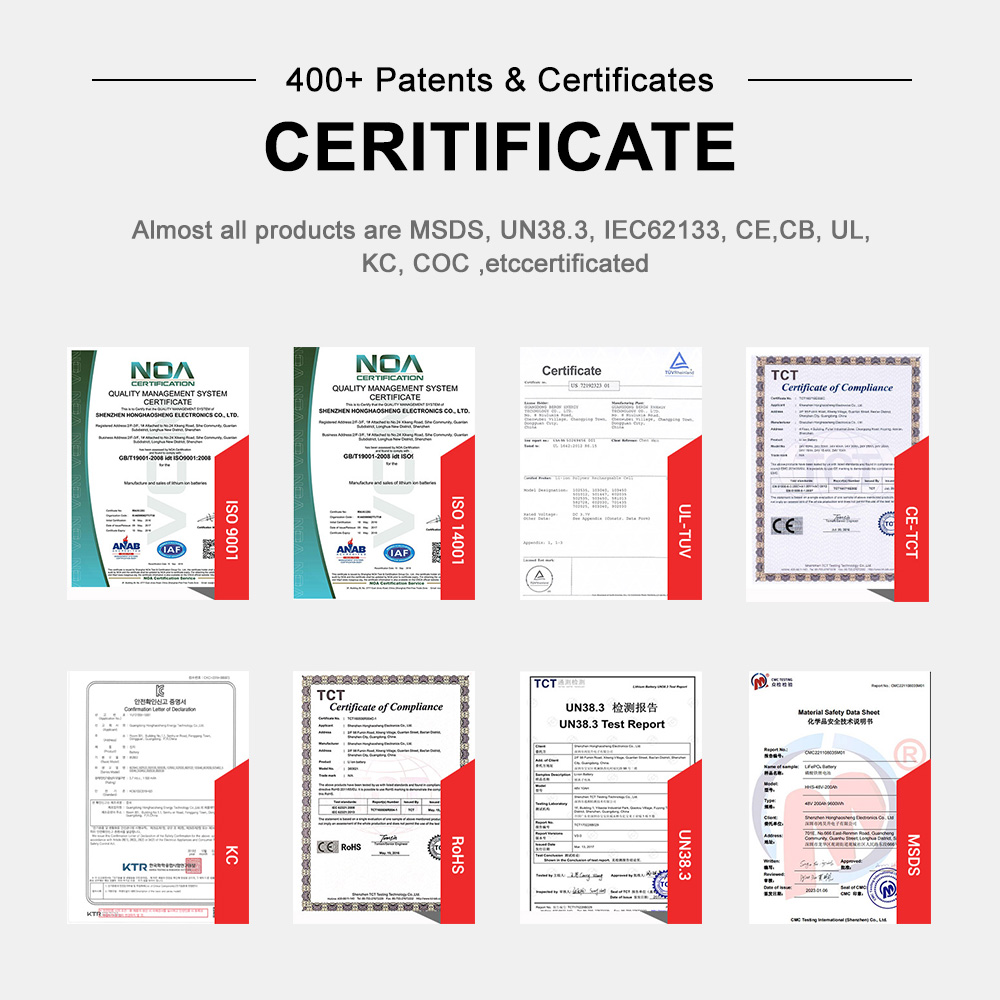
Depending on the destination market and application, buyers may encounter certifications and standards such as UL 2271, IEC 62619, UN 38.3, CE, RoHS, REACH, and ISO 9001. Understanding the difference can help buyers avoid a common mistake: assuming that a battery carrying several certification logos is automatically certified for every application and every market.
Why Do Golf Cart Batteries Need Certifications?
Golf cart batteries, especially lithium-ion and LiFePO₄ batteries, can contain a large amount of stored electrical energy. A battery failure can potentially involve electrical hazards, overheating, short circuits, thermal events, mechanical damage, charging failures, and transportation risks.
Certification and testing requirements are designed to help evaluate these risks and establish consistent safety requirements.
For B2B customers, certifications can also help with importing batteries, selling in different countries, meeting customer procurement requirements, vehicle OEM approval, insurance requirements, transportation, product liability management, and retailer or distributor qualification.
The Most Important Golf Cart Battery Certifications and Standards
| Standard / Certification | Main Purpose | Relevance to Golf Cart Batteries |
|---|---|---|
| UL 2271 | Battery safety for light electric vehicle applications | Highly relevant in applicable markets |
| IEC 62619 | Safety of industrial lithium cells and batteries | Directly covers golf carts |
| UN 38.3 | Lithium battery transportation testing | Important for shipping |
| CE | EU market conformity | Important for applicable EU products |
| RoHS | Restriction of hazardous substances | Relevant for applicable products sold in the EU |
| REACH | Chemical substance requirements | Relevant for EU market access |
| ISO 9001 | Quality management system | Evaluates manufacturer quality processes |
| MSDS/SDS | Safety information documentation | Important for handling and transportation |
Certification does not mean the same thing as testing. A test report, declaration of conformity, certification mark, and quality-management certificate are different types of documents.
UL 2271: A Key Standard for Golf Cart Battery Safety
UL 2271 is one of the most important standards to understand when evaluating lithium batteries for light electric vehicle applications. UL Solutions identifies UL 2271 as the Standard for Batteries for Use in Light Electric Vehicle (LEV) Applications. This standard is particularly relevant to battery packs used in certain light electric vehicle applications.
What Does UL 2271 Tell Buyers?
- When a battery is properly certified, buyers gain additional confidence that the product has been evaluated against defined safety requirements.
- Buyers should verify exact product model, certification scope, manufacturer, cell configuration, battery configuration, rated voltage, and certification listing.
- Do not assume that a manufacturer using the phrase “UL cells” automatically means the complete golf cart battery is UL 2271 certified.
UL 2271 vs. UL 2580: UL 2580 is for electric vehicles (road vehicles). Golf carts should not automatically be treated as passenger EVs. The appropriate standard depends on the vehicle and application.
IEC 62619: An Important International Battery Safety Standard
IEC 62619:2022 specifies safety requirements and tests for secondary lithium cells and batteries used in industrial applications. Importantly, its scope explicitly includes motive applications such as forklift trucks, golf carts, AGVs, railway vehicles, and marine vehicles, while excluding road vehicles.
This makes IEC 62619 especially relevant to golf cart battery applications.
UL 2271 vs. IEC 62619: They are not interchangeable. UL 2271 is particularly relevant to North American LEV applications, while IEC 62619 is an international standard that explicitly includes golf carts.
UN 38.3: Essential for Lithium Battery Transportation
UN 38.3 is not a certification that says a battery is “safe for all applications.” Instead, it relates specifically to the transportation testing of lithium cells and batteries. Tests include altitude simulation, thermal testing, vibration, shock, external short circuit, impact/crush, overcharge, and forced discharge.
Why Is UN 38.3 Important? Lithium batteries are classified as dangerous goods for transportation, so manufacturers and shippers need appropriate documentation. UN 38.3 compliance is an important part of the shipping process.
UN 38.3 Is Not the Same as UL Certification. UN 38.3 focuses on transportation testing, while UL 2271 focuses on battery safety. A battery can have UN 38.3 documentation without being UL 2271 certified.
CE, RoHS, REACH – Market Compliance
CE Marking: Not a battery safety certificate from one testing organization. It is a conformity marking associated with applicable EU legislation. For batteries, the EU Batteries Regulation establishes requirements. Ask for the EU Declaration of Conformity and verify it applies to the exact battery model.
RoHS Compliance: Restriction of Hazardous Substances – associated with restrictions on certain hazardous substances in electrical and electronic equipment. It is about restricted substances, not battery safety.
REACH Compliance: Registration, Evaluation, Authorisation and Restriction of Chemicals – a European regulatory framework related to chemicals. It helps demonstrate that the product and its materials meet applicable chemical requirements.
ISO 9001 & MSDS/SDS
ISO 9001: A quality management system standard. It does not certify a specific battery model. It provides confidence that the manufacturer has structured processes for quality management, production control, documentation, corrective actions, and continuous improvement. ISO 9001 ≠ battery safety certification.
MSDS / SDS (Safety Data Sheet): Provides information relevant to safe handling, storage, transportation, and emergency response. It is useful documentation but not a product safety certification.
What Certifications Does a Golf Cart Battery Need?
There is no universal list. Requirements depend on:
- Battery chemistry (LiFePO₄, NMC, lead-acid, etc.)
- Battery design (single pack, modular, integrated BMS)
- Vehicle application (golf cart, utility vehicle, etc.)
- Destination market (US, EU, Australia, etc.)
- Transportation method (sea, air, road)
- Customer requirements (OEM, fleet, distributor, etc.)
For the U.S. market: Pay particular attention to the applicable UL standard (UL 2271 for many LEV applications) and UN 38.3 for transportation.
For the European market: Consider CE conformity, EU Declaration of Conformity, applicable battery safety standards, RoHS, REACH, transportation requirements, labeling, and technical documentation. The regulatory framework is evolving, so verify current requirements.
Why Certification Scope Matters & Cell vs. Pack Certification
Certification belongs to a specific product configuration. Changes to cell model, cell supplier, number of cells, BMS, enclosure, wiring, connector, capacity, voltage, firmware, or protection settings can affect certification scope or require reassessment.
Cell certification is not pack certification. The cells may be UL certified, but the complete battery pack includes BMS, busbars, connectors, fuses, wiring, enclosure, sensors, software, and protection circuitry. The complete pack must be evaluated according to the applicable requirements.
For golf cart OEMs, this distinction is especially important.
What Should Golf Cart Battery Buyers Ask Suppliers?
- Product Identification: Exact model number, voltage, capacity, cell chemistry, cell model, BMS model.
- Safety Documentation: UL certification or report (where applicable), IEC 62619 test documentation, UN 38.3 test report, SDS/MSDS.
- Market Compliance: CE documentation, RoHS documentation, REACH-related documentation.
- Manufacturing: ISO 9001 certification, factory quality-control procedures, production testing, traceability system.
- Certification Scope: Does the certification apply to the exact battery model being purchased?
Certification vs. Test Report vs. Declaration – understand the differences to prevent costly misunderstandings.
Why Certifications Matter for Dealers and OEMs
For distributors: Certifications affect import, warehouse, shipping, insurance, fleet customers, OEM partners, retail, and government procurement. Lack of documentation can cause delays.
For OEMs: The battery becomes part of the vehicle’s electrical system. OEMs need to verify battery safety, charger compatibility, BMS behavior, motor/controller compatibility, temperature protection, mechanical installation, EMC, transportation compliance, and regional market requirements. A battery supplier experienced in OEM/ODM projects should support the documentation and testing process.
Certification Is Only One Part of Battery Quality
A certified battery is not automatically the best battery for every application. Buyers should also evaluate:
- Cell Quality: Are high-quality cells used?
- Cell Consistency: Are cells properly matched?
- BMS: Does the BMS support the required continuous and peak current?
- Thermal Management: How does the battery manage high and low temperatures?
- Mechanical Design: Can the enclosure withstand vibration and impact?
- Production Testing: Is every battery pack tested before shipment?
- Traceability: Can the manufacturer trace cells, components, and production batches?
- Warranty: What happens if a battery fails?
Certification should be viewed as one part of a broader supplier-quality evaluation.
A Practical Golf Cart Battery Certification Checklist
Product Safety
- ☐ Applicable battery safety standard identified
- ☐ UL 2271 evaluated where applicable
- ☐ IEC 62619 evaluated where applicable
- ☐ BMS protection verified
- ☐ Temperature protection verified
Transportation
- ☐ UN 38.3 testing/documentation
- ☐ Appropriate SDS/MSDS
- ☐ Correct battery shipping classification
- ☐ Packaging requirements confirmed
Market Compliance
- ☐ CE requirements reviewed for EU market
- ☐ RoHS requirements reviewed where applicable
- ☐ REACH requirements reviewed where applicable
- ☐ Required labeling confirmed
Manufacturer & Scope
- ☐ ISO 9001 or appropriate quality system
- ☐ Production testing & traceability
- ☐ Exact battery model verified
- ☐ Certification documents are current
- ☐ Certification body/database can be verified
Never evaluate a battery based only on certification logos printed on a website or product label.
How HHS Energy Approaches Golf Cart Battery Quality
For B2B golf cart battery customers, certifications are most valuable when combined with controlled manufacturing and comprehensive battery testing. HHS Energy’s lithium battery manufacturing capabilities cover customized battery solutions for applications including golf carts, with battery configurations designed around requirements such as voltage, capacity, dimensions, BMS, discharge current, and operating environment.
For OEM and ODM projects, certification requirements can be considered alongside the battery’s electrical and mechanical design rather than being treated as an afterthought. Customers should communicate their target country, golf cart platform, battery specifications, and required certifications at the beginning of the project.
HHS Energy can provide customized lithium battery solutions for B2B customers looking for golf cart battery manufacturing and OEM/ODM support.
Frequently Asked Questions About Golf Cart Battery Certifications
What certification is most important for a golf cart lithium battery?
There is no single universally most important certification. UL 2271 can be important for applicable LEV batteries, while IEC 62619 explicitly includes golf carts. UN 38.3 is important for transportation.
Is UN 38.3 a safety certification?
UN 38.3 is primarily a transportation testing requirement for lithium cells and batteries. It should not be treated as equivalent to an application-specific battery safety certification such as UL 2271.
Is CE the same as UL?
No. CE marking is associated with applicable European Union conformity requirements, while UL standards and certifications are a different conformity and safety framework. They serve different markets and purposes.
Does UL 2271 apply to every golf cart battery?
Not automatically. UL 2271 is a standard for batteries used in light electric vehicle applications. The applicable standard depends on the specific vehicle, battery, market, and regulatory requirements.
Is IEC 62619 suitable for golf cart batteries?
Yes, IEC 62619:2022 specifically identifies golf carts among the motive applications within its scope, while excluding road vehicles.
Does ISO 9001 certify a golf cart battery?
No. ISO 9001 concerns an organization’s quality management system. It does not certify the safety of a specific battery model.
Are UL-certified cells enough for a UL-certified golf cart battery?
No. Cell-level certification and complete battery-pack certification are different. The battery pack contains additional components and must be evaluated according to the applicable requirements.
What documents should I request from a golf cart battery supplier?
At minimum, depending on your market and application, request the applicable safety documentation, UN 38.3 transportation documentation, SDS/MSDS, market-compliance documents, and manufacturer quality certifications. Most importantly, verify that the documents correspond to the exact battery model you are purchasing.
Final Thoughts
Golf cart battery certifications can look complicated because different documents serve different purposes. The easiest way to understand them is to divide them into four categories:
- Battery Safety: UL 2271, IEC 62619 and other applicable standards.
- Transportation: UN 38.3 and associated dangerous-goods documentation.
- Market Compliance: CE and applicable environmental and chemical requirements such as RoHS and REACH.
- Manufacturing Quality: ISO 9001 and the manufacturer’s internal quality-control systems.
For golf cart battery dealers, distributors, OEMs, and fleet operators, certification should never be evaluated in isolation. A high-quality battery should combine appropriate certification, quality cells, a properly engineered BMS, robust mechanical construction, controlled manufacturing, comprehensive testing, and complete documentation.
Most importantly, always verify that the certification applies to the actual battery model and configuration you intend to purchase. As golf carts increasingly transition from lead-acid to lithium technology, understanding battery certifications is becoming an essential part of responsible supplier selection and long-term fleet management.
Need a certified golf cart battery solution?
HHS Energy provides custom lithium battery packs with the right certifications for your target market. We help you navigate UL 2271, IEC 62619, UN 38.3, CE, RoHS, and more.
HHS Energy — Lithium Battery Solutions for Golf Carts & Electric Vehicles
© 2025 HHS Energy | Smart Battery Technology
Related articles
Last updated on September 21, 2026
golf-energy
Golf Cart Lithium Battery Blog, Testing, Maintenance & Replacement
Best Practices for Effective Golf Cart Battery Maintenance