Choosing the right battery is one of the most important decisions for golf cart owners. The battery you select directly affects range, power, lifespan, and long-term operating costs. Two brands often compared by golf cart users are HHS Energy and Trojan Battery Company.
While Trojan has long been associated with traditional lead-acid golf cart batteries, HHS Energy focuses on modern LiFePO₄ lithium technology designed for newer electric mobility applications.
This article provides a detailed comparison of performance, lifespan, efficiency, maintenance, and overall value to help you determine which option better suits your golf cart.
Brand Background
HHS Energy
HHS Energy specializes in lithium battery systems for electric vehicles, energy storage, and golf carts. Their golf cart batteries commonly use LiFePO₄ chemistry, which is known for safety, long cycle life, and high efficiency.
Key focus areas include:
-
Lithium golf cart batteries (48V systems)
-
Integrated Battery Management Systems (BMS)
-
Smart monitoring features like Bluetooth
-
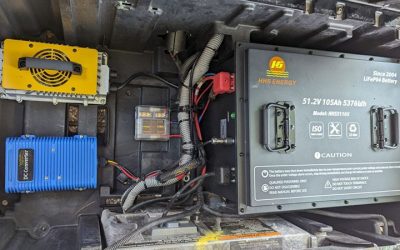
Lightweight drop-in replacement designs
Trojan Battery Company
Trojan Battery Company is one of the most recognized names in the golf cart battery industry. Founded in 1925, the company built its reputation on durable deep-cycle lead-acid batteries used in golf carts, floor machines, and renewable energy systems.
Trojan batteries are widely used in carts from manufacturers such as:
-
Club Car
-
E-Z-GO
-
Yamaha
1. Battery Technology
The biggest difference between these two brands is the battery chemistry.
| Feature | HHS Energy | Trojan |
|---|---|---|
| Battery Type | Lithium LiFePO₄ | Flooded lead-acid / AGM |
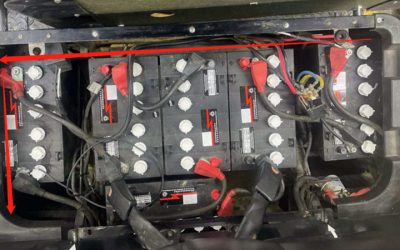
| Nominal System | 48V lithium packs | Multiple 6V / 8V batteries |
| Internal BMS | Yes | No |
| Cell balancing | Automatic | Not available |
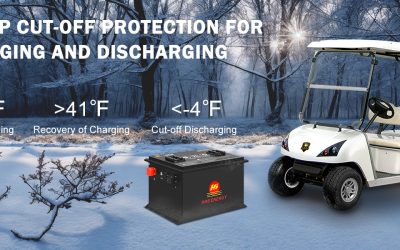
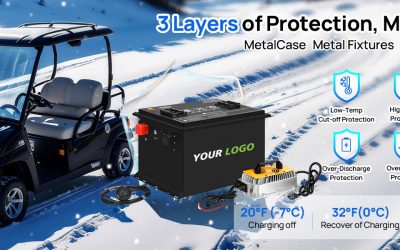
Lithium batteries like those from HHS Energy use advanced battery management systems to balance cells and protect the battery during charging and discharging.
Lead-acid batteries rely on simpler chemical reactions and do not include electronic management systems.
Result: Lithium technology generally provides more consistent and stable performance.
2. Performance and Power Delivery
Power delivery plays a major role in driving experience.
HHS Energy Lithium Batteries
-
Stable voltage throughout the discharge cycle
-
Strong acceleration
-
Better hill-climbing capability
-
Minimal voltage sag under heavy loads
Trojan Lead-Acid Batteries
-
Voltage gradually drops during use
-
Power decreases as the battery drains
-
Performance varies depending on charge level
For carts used in hilly neighborhoods or heavier passenger loads, lithium systems often provide a more consistent driving experience.
3. Weight and Efficiency
Weight affects both efficiency and performance.
| Battery Type | Approximate Weight (48V System) |
|---|---|
| Trojan Lead-Acid Pack | 300–400 lbs |
| HHS Energy Lithium | 80–120 lbs |
The lighter lithium battery offers several benefits:
-
Improved acceleration
-
Reduced stress on suspension
-
Better range
-
Easier installation
Less weight also means higher energy efficiency for the cart’s motor.
4. Lifespan and Cycle Life
Battery lifespan is one of the biggest long-term cost factors.
| Battery Type | Typical Cycles | Average Lifespan |
|---|---|---|
| Trojan Lead-Acid | 500–800 cycles | 3–5 years |
| HHS Energy LiFePO₄ | 3000–6000 cycles | 8–10+ years |
Lithium batteries can last four to six times longer than traditional lead-acid batteries.
Although lithium batteries typically cost more upfront, their longer lifespan often results in lower total ownership cost over time.
5. Charging Time
Charging speed is another area where lithium technology excels.
HHS Energy Lithium
-
3–5 hours typical charging time
-
No memory effect
-
Partial charging is safe
Trojan Lead-Acid
-
8–12 hours charging time
-
Best charged fully each cycle
-
Overcharging can reduce lifespan
Faster charging makes lithium batteries ideal for daily-use carts and fleet operations.
6. Maintenance Requirements
Lead-acid batteries require routine maintenance.
Trojan Batteries
Owners must regularly:
-
Check water levels
-
Clean corrosion from terminals
-
Ensure proper ventilation
-
Perform equalization charging
HHS Energy Lithium
Lithium batteries are essentially maintenance-free.
There is:
-
No watering
-
No acid leakage
-
No corrosion cleanup
This convenience is one of the main reasons lithium batteries are increasingly popular.
7. Smart Features
Modern lithium batteries often include advanced monitoring tools.
Many HHS Energy batteries feature:
-
Bluetooth monitoring
-
Real-time battery status
-
Charge level tracking
-
Temperature monitoring
-
Cycle history
Traditional lead-acid batteries like those from Trojan typically rely on basic voltage indicators instead of integrated electronics.
8. Environmental Impact
Environmental considerations are becoming increasingly important.
Lead-Acid Batteries
-
Contain lead and acid
-
Require specialized recycling
-
Shorter lifespan increases waste
LiFePO₄ Batteries
-
No heavy metals like cobalt
-
Longer lifespan reduces replacement frequency
-
More energy-efficient
For many users, lithium offers a more sustainable long-term solution.
9. Cost Comparison
Initial cost differences can influence purchasing decisions.
| Battery Type | Typical Initial Cost |
|---|---|
| Trojan Lead-Acid Pack | Lower upfront cost |
| HHS Energy Lithium | Higher upfront cost |
However, when considering:
-
Replacement frequency
-
Maintenance costs
-
Charging efficiency
-
Performance benefits
Lithium batteries often become more economical over the long term.
Which Battery Is Better for Your Golf Cart?
The best choice depends on how you use your cart.
Choose Trojan if you:
-
Prefer traditional battery systems
-
Want the lowest upfront cost
-
Use your golf cart occasionally
Choose HHS Energy if you:
-
Want longer battery lifespan
-
Prefer maintenance-free operation
-
Need stronger performance
-
Use your cart frequently
-
Want modern smart features
Final Thoughts
Both HHS Energy and Trojan Battery Company offer reliable solutions for golf cart owners, but they represent two different generations of battery technology.
Trojan batteries remain a trusted choice for traditional lead-acid systems. However, lithium batteries from HHS Energy provide advantages in weight, lifespan, efficiency, and smart monitoring.
As golf carts continue evolving beyond the golf course into everyday transportation, lithium batteries are increasingly becoming the preferred upgrade for modern electric mobility.