Golf carts—also known as golf buggies in many regions—have evolved far beyond simple course transportation. Today, they are widely used in gated communities, resorts, industrial parks, campuses, and as road-legal low-speed vehicles (LSVs). At the heart of this evolution lies one critical component: the battery system.
Over the past two decades, lithium golf cart batteries have steadily replaced traditional lead-acid solutions, redefining performance, reliability, and ownership costs. This article explores the full evolution of lithium golf cart (buggy) batteries, why they are becoming the global standard, and what the future holds.
1. The Early Days: Lead-Acid Dominance in Golf Carts
For decades, golf carts relied almost exclusively on flooded lead-acid batteries. These batteries were popular because they were:
-
Relatively inexpensive upfront
-
Widely available
-
Simple in design
However, they came with significant drawbacks:
-
Heavy weight (often 300–400 lbs per pack)
-
Frequent maintenance (watering, corrosion cleaning)
-
Limited usable capacity (typically only 50%)
-
Short lifespan (3–5 years under ideal conditions)
As golf carts expanded beyond golf courses into daily transportation roles, these limitations became increasingly obvious.
2. The First Transition: AGM and Gel Batteries
To address maintenance issues, manufacturers introduced AGM (Absorbent Glass Mat) and gel batteries.
Improvements Over Flooded Lead-Acid:
-
Sealed and maintenance-free
-
Reduced acid leakage
-
Slightly better vibration resistance
But Problems Remained:
-
Still heavy
-
Still limited depth of discharge
-
Still short cycle life
-
Higher cost with only marginal performance gains
This stage represented a transitional phase, not a true solution.
3. The Lithium Breakthrough: Why LiFePO₄ Changed Everything
The real transformation began with the adoption of Lithium Iron Phosphate (LiFePO₄) chemistry.
Unlike other lithium chemistries, LiFePO₄ offered:
-
Exceptional thermal stability
-
Long cycle life
-
High safety margins
-
Consistent voltage output
This made it ideal for golf cart and golf buggy applications, where safety, reliability, and predictable performance are critical.
4. Key Advantages That Drove Lithium Adoption
🔋 1. Massive Weight Reduction
A lithium golf cart battery typically weighs 60–70% less than an equivalent lead-acid pack.
This reduction improves:
-
Acceleration
-
Hill-climbing ability
-
Tire and suspension life
-
Overall efficiency
⚡ 2. Full Usable Capacity
LiFePO₄ batteries allow 90–100% depth of discharge without damage.
This means:
-
A 100Ah lithium battery often outperforms a 180–200Ah lead-acid system
-
More usable range per charge
-
No voltage sag under load
🔁 3. Longer Lifespan
Typical lifespan comparison:
| Battery Type | Cycle Life | Average Service Life |
|---|---|---|
| Flooded Lead-Acid | 300–500 | 3–5 years |
| AGM / Gel | 500–800 | 4–6 years |
| LiFePO₄ | 3,000–5,000+ | 8–12+ years |
This longevity dramatically lowers total cost of ownership.
5. The Role of Smart BMS in Modern Golf Cart Batteries
The evolution of lithium golf cart batteries isn’t just about chemistry—it’s also about electronics.
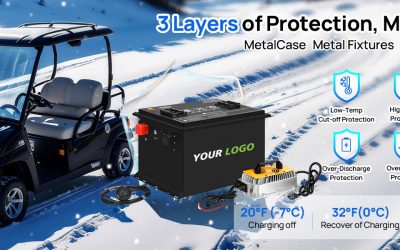
Modern lithium packs integrate a Battery Management System (BMS) that:
-
Balances individual cells
-
Prevents over-charge and over-discharge
-
Protects against over-current
-
Monitors temperature in real time
-
Ensures stable voltage delivery
Brands such as ECO Battery, Bolt Energy, ROYPOW, Allied Battery, and HHS Golf Energy have invested heavily in BMS optimization specifically for golf cart duty cycles.
6. Voltage Evolution: From 36V to 48V and Beyond
Early Systems: 36V
-
Common in older golf carts
-
Limited power and torque
-
Less suitable for modern accessories
Modern Standard: 48V
Today, 48V lithium golf cart batteries (often 51.2V nominal) dominate the market because they:
-
Deliver stronger torque
-
Support higher efficiency motors
-
Power accessories like lights, screens, and audio systems
-
Enable road-legal LSV upgrades
High-Performance Builds
Some specialized applications now use:
-
60V or 72V lithium systems
-
Custom controllers and drivetrains
7. Lithium Batteries and Road-Legal Golf Carts (LSVs)
As regulations evolve, many golf carts are converted into street-legal low-speed vehicles.
Lithium batteries play a crucial role by providing:
-
Stable voltage for headlights, turn signals, and brake lights
-
Consistent power for longer daily driving
-
Compatibility with DC-DC converters
-
Reduced risk of voltage drop during night driving
This trend has accelerated lithium adoption across residential and municipal markets.
8. Plug-and-Play Lithium Kits: Simplifying the Upgrade
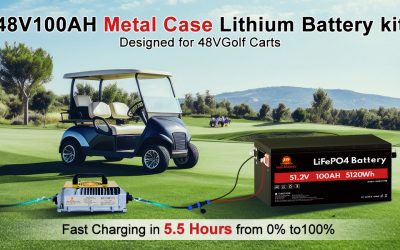
Early lithium conversions required complex wiring and custom configurations. Today’s lithium golf cart batteries are often designed as drop-in replacement kits, featuring:
-
Single-pack designs replacing multiple lead-acid batteries
-
Pre-configured voltage
-
Integrated BMS
-
Clear installation guides
Manufacturers like Allied Battery and HHS Golf Energy focus heavily on DIY-friendly installation, making lithium upgrades accessible to more users.
9. Environmental and Sustainability Impact
Lithium golf cart batteries also align with modern sustainability goals:
-
No acid spills or lead contamination
-
Longer lifespan reduces waste
-
Higher efficiency lowers energy consumption
-
Reduced maintenance chemicals and water usage
For resorts, golf courses, and fleet operators, this environmental benefit is becoming just as important as performance.
10. The Future of Lithium Golf Cart (Buggy) Batteries
Looking ahead, several trends are shaping the next phase of evolution:
-
Smarter BMS with Bluetooth and remote diagnostics
-
Higher energy density without sacrificing safety
-
Improved cold-weather performance
-
Standardized charging protocols
-
Better integration with vehicle electronics
Brands like ECO Battery, Bolt Energy, ROYPOW, Allied Battery, and HHS Golf Energy continue to push innovation, focusing on reliability rather than gimmicks.
Final Thoughts: A Technology That Has Fully Matured
Lithium golf cart batteries are no longer a niche upgrade—they are the new standard.
From improved range and power to longer lifespan and lower lifetime costs, the evolution from lead-acid to LiFePO₄ represents one of the most impactful changes in golf cart history.
Whether you call them golf cart batteries or golf buggy batteries, lithium solutions are powering the next generation of electric mobility—quietly, efficiently, and reliably.